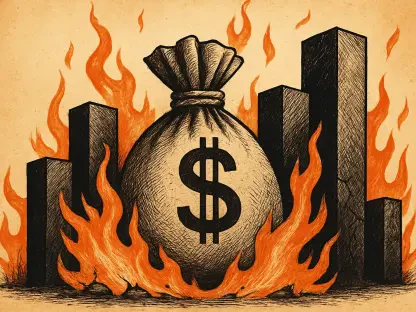

The cryptocurrency market projected for 2026 represents a landscape so fundamentally transformed from its speculative origins that old strategies are not just obsolete but actively detrimental to capital preservation. As the digital asset space continues its march toward maturity, the path to sustained profit has narrowed considerably for the retail investor, while the potential for catastrophic loss has amplified. This analysis presents a strategic framework for this new environment, advocating a pivot from high-risk gambles toward a disciplined, data-driven methodology. The prevailing philosophy for success is no longer centered on rapid wealth accumulation but on strategic survival, rewarding participants who prioritize calculated risk management and long-term discipline over the fleeting allure of market hype.
The End of an Era How Crypto Matured Beyond Retail Speculation
The freewheeling “Wild West” period of cryptocurrency, where fortunes were built on retail sentiment and simplistic market timing, is definitively over. Strategies that once proved effective in previous bull cycles have become relics of a less sophisticated market. The evolution of the digital asset space into 2026 is defined by two primary forces: the deep-seated influence of institutional capital and the establishment of a comprehensive global regulatory fabric. These developments have irrevocably altered market dynamics, raising the stakes for every investor.
A fundamental understanding of this paradigm shift is critical for survival. The market is no longer a retail-driven playground but a highly complex ecosystem where individuals must contend with well-capitalized, technologically superior entities. This new reality necessitates a complete overhaul of the average investor’s mindset, tools, and strategic approach. The transition from a sentiment-driven market to one governed by algorithms and institutional flows marks a point of no return, demanding greater rigor and adaptability from all participants.
A Deep Dive into the Modern Risk Landscape
Macro Forces Shaping Market Behavior
The 2026 market is characterized by a confluence of powerful forces that create a precarious environment for the unprepared. Institutional dominance has introduced deeper liquidity, making it more difficult for prices to experience explosive moves but simultaneously easier for large players to engineer convincing “fake breakouts” and “fake breakdowns” designed specifically to trap retail capital. On-chain data confirms that institutional and whale ownership sits at a multi-year high, meaning price action is now predominantly driven by complex algorithms rather than simple crowd psychology.
Furthermore, tightening global regulations, from Europe’s Markets in Crypto-Assets (MiCA) framework to expanded U.S. oversight of exchange-traded products, have fragmented the global market. This creates significant regional friction in terms of fees, liquidity, and the availability of specific assets. This institutional-grade market has also witnessed a resurgence of extreme volatility. Price charts are increasingly rife with erratic swings—including manufactured rallies, sharp liquidating dips, short squeezes, and long wipes—that render prediction-based trading models almost entirely useless and expose investors to sudden, severe losses.
Unforced Errors The Psychology of Retail Capital Destruction
While external market forces create a dangerous landscape, the most immediate threats to capital often originate from within, manifesting as common and costly investor mistakes. The primary error is over-trading in volatile conditions; the psychological compulsion to act frequently in a chaotic market leads directly to mounting transaction fees and emotionally charged, poorly conceived decisions. This is compounded by consistently poor risk management, including making excessively large bets relative to portfolio size, utilizing high leverage, and neglecting to implement clear stop-losses.
Another significant pitfall is the tendency to follow social media hype propagated by influencers whose bold predictions are often little more than hindsight bias presented as expertise. Many investors also suffer from portfolio over-concentration, creating a single point of failure by allocating a disproportionate amount of capital to a single token. Finally, a critical modern error is the failure to consult on-chain data. In an era of sophisticated participants, relying on intuition instead of objective signals from analytical tools like Glassnode or DefiLlama is a strategy destined for failure.
The Silent Erosion of Profitability
Beyond market volatility and strategic blunders, a more subtle yet equally corrosive force is continuously at play: the slow degradation of capital through fees and suboptimal platform choices. Trading fees, network gas fees, and slippage represent the most consistent and predictable sources of financial drain, especially for participants who trade frequently or engage with decentralized finance protocols. While professional traders meticulously focus on minimizing these operational costs, retail investors often overlook them, allowing these “invisible losses” to significantly diminish annual returns over time.
This problem is exacerbated by the fragmented regulatory landscape, which transforms the choice of a trading exchange into a critical strategic decision. Using a platform that is not optimized for a specific geographic region can inflate costs by as much as 30-70% due to unfavorable fiat on-ramp options, excessive withdrawal fees, and burdensome compliance requirements. Such inefficiencies can turn a potentially profitable trading strategy into a net loss before a single successful trade is even executed.
Projecting Future Trajectories Key Trends to Monitor
Looking forward, the trends shaping the 2026 crypto market are poised to intensify. The increasing sophistication of market participants will continue unabated, with algorithmic trading and institutional capital flows assuming an even more dominant role in price discovery. The global regulatory patchwork will likely solidify, demanding that investors maintain a keen and continuous awareness of their regional compliance obligations and the strategic opportunities they present.
Technologically, the rise of powerful narrative-driven sectors, particularly those at the intersection of blockchain with Artificial Intelligence (AI) and Decentralized Physical Infrastructure Networks (DePIN), will present new avenues for substantial growth. However, these emerging ecosystems will also introduce new layers of complexity and risk that require careful analysis. Future-proofing an investment strategy means accepting that the market will only become more challenging. Long-term success will hinge on a steadfast commitment to continuous learning, strategic adaptability, and the unwavering application of sound, defensive financial principles.
A Defensive Framework for Capital Preservation and Growth
To thrive in this advanced environment, investors must adopt a clear, actionable framework built on the principles of defense and discipline. First, costs should be aggressively minimized by selecting exchanges with transparent fee structures and consistently placing limit orders to avoid the negative impact of slippage. Second, Dollar-Cost Averaging (DCA) should be employed to methodically build positions in foundational assets, removing emotion from the investment process by committing to a fixed investment at regular intervals.
A core-satellite portfolio structure offers a prudent balance between stability and growth. A suggested allocation is 60% in core assets like BTC and ETH, 30% in high-potential ecosystems such as SOL or TON, and a speculative 10% in narrative-driven tokens. Crucially, data must guide all decisions; investors should form a habit of consulting trusted sources like DefiLlama for ecosystem health and Glassnode for on-chain market signals. Finally, a deep understanding of one’s regional crypto environment is necessary to optimize for local regulations and fees, while a multi-layered security stack using cold wallets for storage and reputable exchanges for trading is non-negotiable.
Strategic Imperatives in a Disciplined Market
The 2026 crypto market stood as a testament to a new paradigm that rewarded disciplined strategists over emotional gamblers. The increasing complexity and volatility of the digital asset space demanded a higher level of analytical rigor, where success was no longer defined by the ability to predict the next major price movement but by a steadfast commitment to survival, cost reduction, and data-informed consistency. The analysis revealed that abandoning the search for shortcuts in favor of a methodical, defensive posture was the key to building the resilience needed to weather market storms. By doing so, retail investors could outperform the vast majority of their peers. In this mature and challenging arena, the ultimate hedge against uncertainty was not found in a complex financial instrument, but in the unwavering discipline required to execute a sound and patient strategy.