
A New Frontier in Tech Financing: How GPUs Became Bankable Assets on the Blockchain
In a landmark convergence of artificial intelligence and decentralized finance, the Australian high-performance computing firm Sharon AI has secured a $500 million credit facility from the on-chain lender USD.AI. This groundbreaking deal, announced on January 22, 2026, is not just another large capital raise; it represents a paradigm shift in how capital-intensive tech infrastructure is financed. Instead of relying on traditional corporate balance sheets, the loan is directly secured by the company’s most valuable physical assets: its graphics processing units (GPUs). This article will explore the mechanics behind this innovative financing model, delve into the burgeoning trend of on-chain private credit, and analyze the profound implications for both the AI industry and the future of capital markets.
From Silicon to Collateral: The Evolution of Asset-Backed Lending
For decades, asset-backed lending has been a cornerstone of corporate finance, with companies securing loans against tangible assets like real estate, inventory, and equipment. However, this traditional process is often slow, opaque, and heavily reliant on intermediaries, creating friction for fast-moving industries. The private credit market emerged as a more flexible alternative, yet it suffers from its own challenges, including a lack of transparency and limited liquidity. The AI industry, with its insatiable demand for expensive computational hardware, has magnified the need for a more dynamic financing solution. GPUs, the powerful engines driving the AI revolution, are immensely valuable but have not traditionally been viewed as liquid, bankable collateral, creating a funding gap that innovative on-chain solutions are now beginning to fill.
Deconstructing the Deal: The Mechanics of On-Chain GPU-Backed Credit
Tokenizing Hardware: Turning Physical GPUs into Digital Collateral
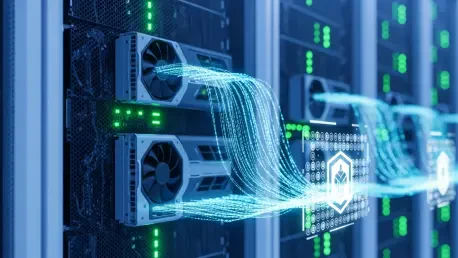
At the heart of the Sharon AI deal is the process of tokenizing real-world assets (RWAs). USD.AI’s system works by verifying the physical deployment and operational status of Sharon AI’s GPUs. Once verified, these hardware assets are represented as unique digital tokens on a blockchain. These tokens serve as the direct, transparent collateral for the non-recourse loan, allowing lenders to monitor the assets’ performance in near real-time. This structure dramatically streamlines underwriting and de-risks the loan, enabling rapid capital deployment—starting with an initial $65 million this quarter. The benefit is unprecedented speed and efficiency, bypassing months of due diligence typical of bank financing.
On-Chain Private Credit: A Disruptive Force in Financial Markets
This financing model is a prime example of on-chain private credit, a sector poised to disrupt the traditional financial landscape. By moving loan agreements onto a blockchain, the process gains a new level of transparency and accessibility. Prominent figures in the digital asset space view private credit as a breakout use case for tokenization, as it can enhance the industry’s safety and reporting standards. They argue that the inherent transparency of blockchain rails provides clear visibility into asset quality and repayment schedules, which could mitigate fraud and attract traditional investors. Even in a default scenario, the clarity surrounding the underlying collateral simplifies the recovery process, a significant advantage over the often-murky world of conventional private credit.
Beyond a Single Deal: Market Validation and an Emerging Consensus
The Sharon AI agreement is not an isolated experiment but a strong indicator of a growing market consensus. USD.AI has already approved over $1.2 billion in similar GPU-backed credit facilities for other major AI infrastructure companies, including QumulusAI and Quantum Solutions. This demonstrates that on-chain, RWA-backed lending has become a viable and increasingly popular alternative for tech sectors with high capital expenditures. It addresses a critical misconception that decentralized finance is disconnected from the real economy. In reality, it is providing a powerful solution for real-world business challenges, creating a faster and more direct path for companies to fund their growth by leveraging their core operational assets.
The Future Trajectory: AI, RWAs, and the Next Generation of Capital Markets
The convergence of AI’s explosive growth and DeFi’s innovative capital solutions signals a powerful emerging trend. The tokenization of real-world assets is set to expand beyond GPUs to include other high-value, tech-related hardware like specialized servers, robotics, and proprietary data centers. As this market matures, we can anticipate the development of new regulatory frameworks designed to govern the link between digital tokens and their physical counterparts, providing greater security for investors. This model is expected to attract a wave of traditional financial institutions seeking to deploy capital into high-yield, transparent credit opportunities, ultimately bridging the gap between legacy finance and the decentralized economy.
Strategic Imperatives: Navigating the New Landscape of Tech Finance
The key takeaways from this analysis are clear: valuable physical assets can now function as liquid, on-chain collateral; on-chain private credit offers a faster and more transparent financing alternative; and this model is rapidly gaining market validation. For AI and other hardware-intensive companies, this presents an actionable strategy to fund expansion without diluting equity or navigating the slow-moving legacy banking system. For investors and lenders, it opens up a new asset class with verifiable collateral and transparent risk profiles. Businesses across all sectors should begin assessing their high-value physical assets and exploring how tokenization could unlock new, efficient sources of capital to fuel growth and innovation.
A Conclusive Outlook: Redefining Value in a Tokenized World
The $500 million on-chain loan secured by Sharon AI is more than just a financial transaction; it is a powerful proof-of-concept for the future of capital formation. It demonstrates that blockchain technology has evolved beyond speculative assets to solve tangible, billion-dollar financing challenges in the real economy. The long-term significance of connecting the value of physical infrastructure to the efficiency of decentralized financial rails cannot be overstated. As the global demand for AI computation continues its exponential rise, the ability to finance the underlying hardware through transparent, on-chain markets will become a critical engine for technological progress.