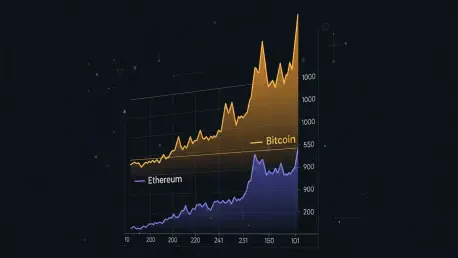

The traditional correlation between the two most prominent digital assets has dissolved into a stark divergence that fundamentally redefines the risk profile of the broader cryptocurrency market. Recent market data spanning the last five years reveals a significant performance gap, as Bitcoin successfully doubled its market valuation while Ethereum struggled to maintain a consistent upward trajectory. This decoupling suggests that the days of a monolithic crypto market, where all major assets moved in tandem regardless of their underlying utility, have largely concluded. Institutional and retail investors alike are now forced to confront a reality where the “store-of-value” narrative provides more financial stability than the “global computer” ambition. As Bitcoin solidifies its position as the undisputed leader in capital preservation, Ethereum faces a critical period of reassessment. The data reflects a maturation of the sector, where capital is no longer distributed indiscriminately but is instead funneled into assets that offer the clearest economic incentives and the most predictable long-term growth.
The Institutional Pivot: Why Bitcoin Emerged as a Primary Store of Value
The transformation of Bitcoin from a speculative digital experiment into a legitimate institutional asset has been the primary engine behind its remarkable performance over the last five years. By focusing on a singular, easily understood narrative—digital gold—Bitcoin has successfully courted conservative financial entities that once viewed the entire sector with skepticism. These investors are drawn to the absolute scarcity of the 21 million unit supply, a feature that provides a mechanical hedge against the inflationary pressures and currency devaluations seen in traditional fiat systems. Unlike more complex platforms, Bitcoin’s simplicity is its greatest strength, offering a transparent and immutable ledger that functions independently of any central authority or corporate roadmap. This clarity of purpose has allowed it to capture the lion’s share of long-term capital, particularly from organizations that prioritize wealth preservation over the high-velocity experimentation found in decentralized finance.
Furthermore, the proliferation of regulated financial products, such as Exchange-Traded Funds, has fundamentally altered the liquidity profile of the asset. These vehicles have bridged the gap between the traditional banking system and the digital economy, allowing trillions of dollars in managed assets to flow into Bitcoin without the technical hurdles of self-custody. This influx of capital has created a self-reinforcing cycle of stability and growth, as deeper liquidity reduces volatility and makes the asset more attractive to risk-averse institutional players. From the current vantage point of 2026, it is clear that the integration of Bitcoin into traditional portfolios from 2026 to 2028 will likely continue this trend of dominance. The asset has moved beyond the “get rich quick” phase of its development, establishing itself as a foundational component of modern macro-investment strategies that value security and scarcity above all other technical considerations or network utility metrics.
Technological Complexity and Competitive Saturation: The Ethereum Dilemma
In contrast to the streamlined narrative of its counterpart, Ethereum has navigated a much more difficult path, characterized by intense technical upgrades and rising competition. While the network remains the undisputed hub for decentralized applications and smart contracts, this high level of utility has not translated into the same level of asset appreciation seen in the Bitcoin market. The transition to more efficient consensus mechanisms and the implementation of various scaling solutions were necessary for the network’s survival, yet they have also introduced a level of complexity that can be daunting for traditional investors. Many market participants now view Ethereum through the lens of a high-growth technology stock rather than a sovereign currency. This shift in perception means that Ether is often valued based on network throughput, developer activity, and transaction fees—metrics that are inherently more volatile and sensitive to market cycles than the simple supply-and-demand mechanics of a digital commodity.
The landscape has also been complicated by the emergence of alternative blockchain platforms that offer faster transactions and lower costs, effectively challenging Ethereum’s early-mover advantage. This competitive saturation has fragmented the liquidity that was once concentrated within a single ecosystem. As newer protocols capture significant portions of the decentralized finance market, Ethereum is forced to innovate constantly just to maintain its current position. This “workhorse” status creates a paradox where the network becomes more useful every day, yet the price of the token remains suppressed by the constant need to reinvest in infrastructure and the dilution of market share. For investors who are looking for a reliable store of value, this constant state of flux represents a higher risk profile compared to the relatively static and predictable nature of Bitcoin. The result is a market where utility and price are no longer perfectly correlated, leaving Ethereum in a persistent state of price stagnation.
Regulatory Tailwinds: Solidifying the Legal Foundation for Digital Commodities
The diverging performance between these two assets is also deeply rooted in the evolving regulatory framework, particularly within the United States. Bitcoin has benefited from a level of legal clarity that has yet to be fully extended to other digital assets. By being broadly classified as a commodity, Bitcoin was able to bypass many of the legal hurdles and uncertainties that have plagued more complex tokens. This designation was crucial for the approval of institutional financial products and the participation of major brokerage firms. The regulatory environment has essentially created a “safe harbor” for Bitcoin, making it the default choice for any institution that requires strict compliance and legal certainty. In a financial world that is increasingly defined by risk management, the ability to operate within a clear and established legal framework is a competitive advantage that cannot be overstated, as it directly influences the flow of global capital into specific assets.
Ethereum and other utility-focused platforms have faced a more ambiguous regulatory journey, often finding themselves at the center of debates regarding security classifications and decentralized governance. While the industry has made significant strides in defining the roles of smart contract platforms, the lingering uncertainty has caused many large-scale investors to remain on the sidelines. The threat of sudden regulatory shifts or enforcement actions creates a “risk premium” that weighs heavily on the price of the asset. This discrepancy in legal treatment has allowed Bitcoin to consolidate its lead, as it became the first and often only digital asset that conservative funds were willing to touch. As the market moves forward, the ability of a project to navigate these legal complexities will be just as important as its underlying technology. The current performance gap is a clear indicator that the market values legal durability and predictability just as much as it values technical innovation or decentralized network utility.
Strategic Implications: Adapting to a Bifurcated Digital Asset Landscape
The final analysis of the five-year performance shift revealed that the digital asset market was no longer a single, cohesive entity but had instead split into two distinct categories with different economic drivers. Investors who recognized this shift early were able to capitalize on the stability of Bitcoin while avoiding the volatility and stagnation that characterized the broader utility token market. The data showed that Bitcoin’s role as a macro hedge became its most valuable asset, overshadowing any technical limitations it might have had compared to more modern blockchains. Conversely, the challenges faced by Ethereum served as a reminder that being the most technically advanced or widely used platform did not guaranteed superior financial returns. This divergence suggested that the market had finally matured enough to distinguish between a monetary protocol and a software infrastructure layer, leading to more specialized and efficient allocations of capital across the entire financial ecosystem.
In response to these findings, sophisticated market participants began to restructure their portfolios to reflect the new reality of a bifurcated market. The focus shifted toward treating Bitcoin as a core holding for wealth preservation, similar to gold or long-term treasury bonds, while viewing Ethereum and its competitors as speculative technology bets. This strategic realignment allowed for better risk management and a more realistic expectation of future returns. Moving forward, the most successful participants will likely be those who maintain a clear distinction between assets designed for scarcity and those designed for utility. The actionable path involves monitoring the specific adoption metrics of each category rather than following broad market trends. By understanding that Bitcoin and Ethereum are solving fundamentally different problems, the financial sector ensured that digital assets were integrated into the global economy in a way that maximized their unique strengths while minimizing the risks of a unified, highly volatile market.