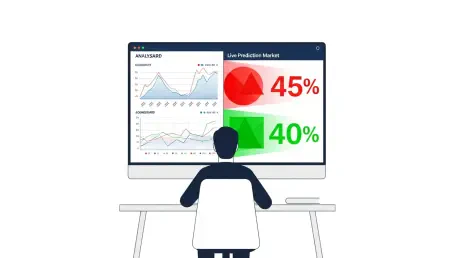

A groundbreaking strategic partnership between the decentralized prediction market platform Polymarket and the financial news giant Dow Jones is set to fundamentally reshape how financial data is consumed and utilized. This collaboration will syndicate Polymarket’s real-time, crowd-sourced data to world-renowned publications, including The Wall Street Journal and Barron’s, effectively building a bridge between the niche world of Web3 and the established institutions of traditional finance. By injecting the predictive power of markets where participants wager real assets on future outcomes directly into the mainstream financial news cycle, this initiative moves beyond theoretical applications. It signals a major shift towards a more dynamic, data-driven financial ecosystem where insights once confined to crypto-native circles become accessible to a global audience of investors, analysts, and corporate decision-makers, heralding a new era for digital banking and strategic forecasting. This integration promises to not only enhance the accuracy of financial sentiment analysis but also to foster a new class of financial tools and strategies built upon the wisdom of the crowd.
The Fusion of Decentralized Data and Traditional Media
Beyond Traditional Polling
Prediction markets offer a significant evolution over conventional forecasting methods like public opinion polls by introducing a crucial element: financial stakes. Unlike polls where respondents face no consequences for incorrect answers, prediction markets require participants to “put skin in the game” by wagering real money on their beliefs about future events. This financial incentive fundamentally alters the quality of the data generated, as it filters out casual speculation and encourages participation from those who are well-informed or have a high degree of confidence in their predictions. The result is a continuously updated stream of data that aggregates the collective wisdom, private information, and real-time analysis of a diverse crowd. This mechanism creates a living, breathing forecast that adjusts instantly to new information, be it a corporate earnings report, a geopolitical development, or a shift in technological trends. For businesses operating in the fast-paced Web3 space, this dynamic data source is an invaluable asset for navigating uncertainty and capitalizing on emerging opportunities.
The availability of this high-fidelity, forward-looking data provides Web3 businesses, decentralized autonomous organizations (DAOs), and startups with a powerful toolkit for enhancing their core operational functions. In the realm of strategic planning, these insights allow organizations to move beyond reactive decision-making and adopt a more proactive posture, anticipating market shifts and positioning themselves accordingly. For risk management, the continuous data flow acts as an early warning system, highlighting potential downturns or adverse events long before they are reflected in traditional market indicators. This enables treasuries to hedge against volatility or reallocate assets to mitigate potential losses. Furthermore, in treasury operations, this predictive data empowers more sophisticated and informed asset management. A DAO’s treasury, for instance, can leverage market probabilities to optimize its holdings, deciding when to convert volatile assets into stablecoins or when to increase exposure to a cryptocurrency that the market predicts is on an upward trajectory, thereby maximizing returns and preserving capital with greater precision.
A New Paradigm for Financial Decision Making
The syndication of Polymarket’s data to prestigious outlets like The Wall Street Journal and Barron’s represents a pivotal moment in the convergence of Web2 and Web3. This move democratizes access to a new class of financial intelligence that was previously the domain of crypto enthusiasts and sophisticated traders. By placing crowd-sourced probabilities alongside traditional financial metrics like stock prices and economic indicators, this partnership legitimizes prediction markets as a valid source of market sentiment. For the global audience of investors, corporate executives, and financial institutions that rely on these publications, this integration provides a novel lens through which to view the future. It allows them to gauge public conviction on a wide range of events, from the outcome of regulatory decisions to the adoption rate of new technologies. This newfound visibility transforms prediction market data from an alternative dataset into a mainstream tool for risk assessment, investment strategy, and corporate planning, fundamentally altering the landscape of financial decision-making.
This collaboration is not an isolated event but rather a significant marker of a broader, accelerating trend: the deep integration of Web3 technologies into real-world, traditional industries. As crypto-native concepts mature, they are increasingly finding practical applications that extend far beyond their original ecosystems. This is evidenced by developments across various sectors, such as Ford’s exploration of incorporating crypto payments into its vehicle systems and ongoing adjustments in crypto exchange mechanisms to better serve institutional clients. The Polymarket-Dow Jones partnership serves as a powerful example of how decentralized information systems can augment and enhance established financial media frameworks. The increasing availability and credibility of such data are expected to act as a catalyst for innovation, fueling the development of next-generation business tools that are natively designed for a hybrid Web2-Web3 world, further enmeshing the digital asset economy with the global financial system and creating more resilient, responsive, and sophisticated markets.
Practical Applications and Future Innovations
Revolutionizing Corporate Treasury and Payroll
One of the most transformative applications of accessible prediction market data is the innovation it enables in corporate finance, particularly within crypto-native payroll systems. Businesses and DAOs that hold and transact in volatile cryptocurrencies face constant risk from market fluctuations, which can dramatically impact the value of their treasury and the compensation they provide to their teams. Prediction market odds offer a powerful mechanism to mitigate this risk. For instance, a DAO’s treasury management team could consult market predictions before processing its monthly payroll. If the collective wisdom of the market indicates a high probability of a significant downturn for an asset like ETH, the organization could proactively convert a portion of its fiat or crypto holdings into stablecoins. This strategic move would preserve the value of the funds earmarked for payroll, ensuring that employees receive their expected compensation without the organization suffering a substantial loss due to a market crash. This approach transforms treasury management from a passive function into a dynamic, forward-looking operation.
Conversely, the same predictive data can be used to capitalize on potential market upswings, creating value for both the organization and its employees. If prediction markets signal a strong probability of a rally for a particular asset, such as ETH, a company could offer its team the option to receive their salary in that cryptocurrency. This creates a high-reward scenario where employees who opt-in could see the value of their compensation increase significantly. This flexibility allows for the creation of dynamic payroll models that can adapt to real-time market sentiment. Organizations can offer their workforce a choice between the stability of a stablecoin-based salary and the higher-risk, potentially higher-reward option of being paid in a more volatile asset. This not only provides a sophisticated tool for treasury management but also serves as an attractive retention and recruitment tool, appealing to talent that is comfortable with and interested in the potential upside of the digital asset economy, fostering a more aligned and engaged workforce.
Fueling Next-Generation Business Tools
The mainstream integration of prediction market data is poised to be a major catalyst for the development of a new generation of sophisticated, crypto-native business tools. As this data becomes more widely available and trusted, developers can create financial dashboards that offer a more holistic view of the market landscape. Imagine a platform that displays prediction market odds on regulatory decisions or protocol upgrades alongside traditional metrics like token price, trading volume, and on-chain analytics. This would provide decision-makers with a multi-dimensional perspective, allowing them to correlate market sentiment with quantitative data to make more nuanced and informed choices. Furthermore, this predictive layer could be integrated into decentralized finance (DeFi) platforms. For example, a lending protocol could use market sentiment about the future stability of a collateral asset as an additional factor in its risk assessment models, automatically adjusting lending parameters or interest rates based on the crowd’s perceived risk, creating more resilient and adaptive financial systems.
Looking further ahead, the synthesis of predictive data with artificial intelligence could unlock even more advanced applications. AI-driven treasury management systems could be designed to automatically execute trades and rebalance portfolios based on real-time data from prediction markets. Such a system could, for instance, automatically shift a portion of a DAO’s treasury from a volatile asset into a stablecoin if the market predicts a price drop with a certain probability, all without human intervention. This would enable organizations to manage their digital assets with an unprecedented level of efficiency and risk mitigation. While significant hurdles, including regulatory clarity and the challenges of achieving widespread mainstream adoption, remained, the momentum had undeniably shifted. The fusion of decentralized information networks with traditional financial media established a foundation for a more dynamic, transparent, and data-centric future for digital banking, powered by the collective intelligence of the market.