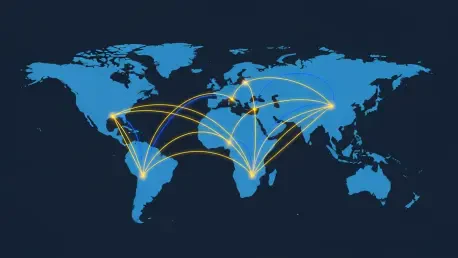

The global financial system, long engineered by and for Western economies, remains fundamentally inaccessible for billions of people in the Global South, creating a chasm that simple digitization has failed to bridge. For years, the prevailing strategy involved exporting ill-fitting banking models and hoping that mobile technology would magically solve deep-seated structural problems, a tactic that often deepened exclusion rather than alleviating it. A new and more radical paradigm is now emerging, one that challenges this entire approach by asking a more profound question: What if we built an entirely new system from the ground up, leveraging artificial intelligence specifically designed to comprehend the unique economic realities of emerging markets? This revolutionary concept, championed by systems thinkers like Tintra founder Dickie Shearer, posits that AI, when built with cultural intelligence, could be the key to unlocking genuine financial inclusion and fostering true economic sovereignty for nations long marginalized by the status quo.
The Problem with “Copy-Paste” Banking
At the heart of the issue lies a fundamental design flaw, not a deficiency in technology. Western banking operates on a specific set of assumptions: formal employment contracts, predictable monthly salaries, standardized credit histories, and formal property ownership. These pillars, while stable in developed nations, are largely absent in the vast, dynamic, and often informal economies of Africa, Latin America, and much of Asia. Exporting these models without adaptation, even when wrapped in a sleek smartphone app, creates a system inherently incapable of seeing, measuring, or valuing the real economic activity of its intended users. This deep cultural and structural mismatch has forced billions into a world of necessary workarounds, from mobile money services acting as fragile substitutes for full banking to informal credit networks and settlement systems that operate entirely outside the formal financial sphere, perpetuating a cycle of financial invisibility and exclusion.
Simply layering artificial intelligence on top of these flawed and mismatched foundations is not only an ineffective solution but a potentially dangerous one. An AI system is only as good as the data it is trained on, and when it learns from decades of Western-centric economic models, it inevitably inherits and amplifies their inherent biases. Instead of fostering greater inclusion, such AI risks accelerating exclusion by optimizing for a financial reality that does not exist for the majority of the world’s population. This could lead to the creation of what Shearer terms “ever more sophisticated intelligence on foundations that don’t reflect reality,” effectively building a faster, more efficient, and more automated system of financial marginalization. The danger lies in using a powerful new tool to reinforce old inequalities, making it even harder for those outside the prescribed Western framework to gain a foothold in the global economy.
A New Foundation Built with Cultural Intelligence
The proposed solution requires a radical shift in perspective, moving away from adaptation and toward ground-up creation by building AI systems with “cultural intelligence” at their very core. This innovative approach involves designing financial infrastructure that does more than just process transactions; it must actively learn from and adapt to local economic behaviors in real time. Such a system would be engineered to understand and quantify value that moves through complex, trust-based social networks, recognize the seasonal income patterns common in agricultural economies, and measure creditworthiness through metrics that a traditional balance sheet or credit score could never capture. In this model, AI ceases to be a superficial add-on or a tool for simple optimization. Instead, it becomes the foundational layer of the entire financial architecture, enabling a system that is inherently responsive, flexible, and reflective of the lived economic reality of its users.
This new approach has the profound potential to completely redefine how economic potential is measured and understood on a global scale. Many nations in the Global South are labeled “poor” not from a genuine lack of vibrant economic activity, but because their formal financial systems are effectively blind to it. A significant majority of their economies operate invisibly within informal markets, through trade, savings, and credit networks that are untraceable by conventional banking infrastructure. A financial system designed with cultural intelligence can transform from a “constraint” into an “amplifier.” By reducing systemic friction and accurately seeing and measuring this vast, previously unseen economic activity, it can begin to bring it into the formal sphere. This not only empowers individuals and small businesses but also unlocks the true, aggregate economic power of these regions, providing a more accurate picture of their wealth and potential for growth.
From Local Insight to Global Sovereignty
This critical technological evolution is unfolding within a much broader geopolitical context of a shifting global order. As the world transitions toward a more multipolar framework, nations across the Global South are increasingly asserting their desire for greater financial sovereignty, actively seeking to reduce their long-standing dependence on the US dollar and Western-controlled clearing and settlement systems. To achieve this, they require new financial infrastructure that prioritizes their unique regulatory environments, cultural contexts, and economic resilience as “first-order constraints,” not as secondary afterthoughts. Culturally intelligent AI can serve as the critical enabling layer for this historic transition. It allows for the creation of dynamic, automated compliance systems that adapt seamlessly to diverse local rules, facilitating regional, South-South trade and settlement without defaulting to external intermediaries or rigid, one-size-fits-all global standards.
This transformative vision is already moving from abstract theory to practical application. Pioneering companies like Tintra are at the forefront, building the next generation of AI-native banking and settlement infrastructure designed explicitly for the needs of emerging markets. With its platform set to launch in 2026, the company is engineering its systems from scratch to facilitate seamless cross-border trade and payments between Africa, Latin America, and other key regions in the Global South. By embedding deep cultural and regulatory intelligence into the core of its architecture, Tintra aims to create a financial network that operates fluidly across different currencies, borders, and compliance realities. This is not about retrofitting an old model but about creating a new one, born from the understanding that true interoperability can only be achieved when a system is designed with the unique realities of its users in mind from day one.
A Necessary and Radical Reframing
The dialogue surrounding global finance ultimately centered on a necessary and radical reframing of the core problem. It became clear that incremental improvements and the simple digitization of fundamentally flawed models were destined to fail, as the central issue was never a lack of access to technology but a foundational mismatch between system design and user reality. The focus shifted away from asking how emerging economies could be forced to fit into the existing global system. Instead, technologists and policymakers began to ask what global finance would look like if it were redesigned with cultural intelligence at its core. This pivotal change in perspective unlocked a future where technology served to amplify the inherent economic vitality of the Global South. The move toward ground-up design and culturally aware AI was not just an innovation; it represented a decisive step toward building a more equitable, resilient, and truly inclusive global financial infrastructure.