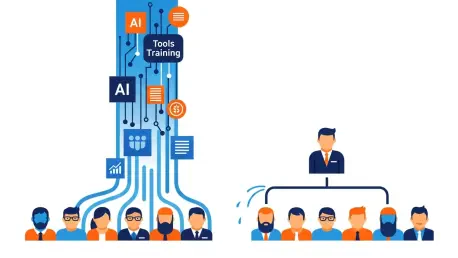

A profound disconnect is rapidly emerging within Canada’s wealth management sector, creating a chasm between the optimistic narrative of an artificial intelligence revolution and the much more complicated on-the-ground reality. Despite significant investment and enthusiastic strategic focus from senior leadership, a new landmark study reveals a critical gap between how executives perceive AI integration and how frontline employees are actually applying these powerful new tools in their daily work. The prevailing myth of an “AI-capable workforce” is being methodically dismantled, exposing an uncomfortable truth: while many firms have achieved superficial adoption, the deep, transformative integration of AI into the core workflows that drive business value remains exceptionally rare. This is not merely a case of a missed opportunity; it represents a growing capability gap and a significant strategic vulnerability for Canadian wealth management firms that have already begun factoring AI-driven productivity gains and efficiencies into their long-term business plans. The findings suggest that for the vast majority of professionals, AI remains a novelty or a tool for trivial tasks, not the foundational, paradigm-shifting technology it was promised to be, demanding a major course correction to bridge the expanding void between ambition and actual implementation.
The Proficiency Paradox Widespread Dabbling Limited Impact
Redefining AI Competence
The very definition of what it means to be proficient with artificial intelligence has undergone a fundamental and rapid transformation over the past year, leaving many organizations behind. Initially, the bar for competence was set relatively low, focusing primarily on basic understanding and, crucially, on risk mitigation. The primary objective for many Canadian advisory firms and dealer networks was to ensure their employees knew what AI tools were, how to formulate a simple prompt, and how to avoid catastrophic data breaches, such as inadvertently uploading sensitive client financial information to public-facing, unsecured chatbots. Successfully implementing training programs that met this early standard was considered significant progress, allowing firms to confidently claim they were embracing the new technological frontier while protecting client interests. This foundational phase was essential, but it represented only the first step on a much longer journey toward true integration, a journey that many firms have yet to seriously undertake.
However, that initial definition of proficiency is now glaringly obsolete in the current landscape, where the competitive advantages of AI are beginning to truly crystallize. Today, genuine proficiency is defined not by occasional experimentation but by the systematic and regular integration of AI into substantive, value-generating tasks that form the backbone of a financial practice. This new standard demands a move beyond sporadic interactions with chatbots for minor administrative duties and into the realm of embedding AI deeply into the core workflows that drive the very economics of financial advice. These critical workflows include a range of complex activities, such as gathering and synthesizing vast amounts of disparate client information, conducting sophisticated financial scenario analyses, performing detailed portfolio reviews, supporting complex tax planning strategies, maintaining rigorous and auditable compliance documentation, and producing the high-quality, personalized deliverables that clients expect. This advanced level of application is where AI transitions from a helpful accessory to a transformative business partner, capable of unlocking unprecedented levels of efficiency, accuracy, and scalability.
The Startling Reality of the Capability Gap
When measured against this more demanding and relevant standard of proficiency, the research reveals that the vast majority of organizations are falling alarmingly short. The data presents a stark paradox: while consumer-facing AI tools like ChatGPT boast nearly 900 million monthly users and over half of all Americans report using AI in some capacity, its application within the professional sphere remains disappointingly cosmetic and peripheral. One of the study’s most jarring findings is that a staggering 85% of workers across all sectors lack what could be considered a “value-driving” use case for artificial intelligence in their daily responsibilities. Further compounding this issue, a full quarter of the entire workforce never uses AI for work purposes at all, indicating a significant portion of employees see the technology as irrelevant or too complex to integrate into their established routines. This reveals that even in roles centered on language, data analysis, and complex problem-solving—the very areas where AI is supposed to excel—its immense potential is not being effectively harnessed, a fact that should be a major concern for any firm that has factored AI-driven productivity gains into its future business projections and strategic plans.
The study further categorizes workers into distinct proficiency levels, painting a clear and concerning picture of a workforce that is merely dabbling in AI rather than truly leveraging its capabilities to drive meaningful outcomes. The largest group, comprising approximately 70% of respondents, are classified as “AI Experimenters.” These individuals use the technology for elementary, low-impact tasks such as condensing meeting notes, adjusting the tone of an email, or performing basic information retrieval that could often be accomplished just as easily with a standard search engine. Another 28% are labeled “AI Novices,” a segment that includes individuals who either avoid AI completely or have only briefly tested it before abandoning it, finding it either irrelevant to their needs or too complicated to master. This leaves a vanishingly small group of effective users. A mere 2.7% of employees qualify as “AI Practitioners,” defined as those who have successfully integrated AI into their regular workflows in a meaningful way and can report substantial productivity improvements as a direct result. At the pinnacle, an almost statistically insignificant 0.08% are considered “AI Experts.” The report’s conclusion from this data is unequivocal and severe: an overwhelming 97% of the workforce is either using AI ineffectively or is not using it at all. This reality check is particularly pointed for Canadian financial planning practices that are already enthusiastically promoting their “AI-enhanced financial advice.” The statistical probability that their teams fall within the high-performing 2.7% is extremely low, suggesting that such marketing claims may be far more aspirational than they are factual.
Identifying the Barriers to Meaningful Adoption
The Use Case Desert
A central argument emerging from the research is that the primary barrier to the effective and widespread adoption of artificial intelligence is not a lack of technical skill or an unwillingness to learn, but rather a profound failure of imagination and practical application. The majority of employees, including those in the wealth management sector, generally understand the basic mechanics of how to interact with a large language model. The challenge is not in the “how” but in the “where” and “why.” Workers are struggling to identify specific, complex problems within their roles and then conceptualize how these advanced tools can be applied to solve them efficiently and effectively. The researchers have termed this widespread phenomenon a “use case desert,” a landscape where the technology is available but its practical, impactful applications remain undiscovered or unarticulated by the very people who stand to benefit from them the most. This gap between potential and practice is proving to be the single greatest impediment to unlocking the productivity gains that AI promises.
The statistics that support this claim are both compelling and concerning, highlighting the depth of the application challenge. Beyond the 26% of respondents who report having no work-related AI application whatsoever, a thorough and qualitative review of 4,500 reported work use cases submitted by survey participants found that a mere 15% were judged by the research team as being likely to produce a genuine, measurable return on investment for their employers. For the Canadian financial planning industry, this translates into a common and frustrating pattern: a financial adviser might use an AI tool to polish the language in client correspondence or to quickly summarize a newly released tax bulletin, but they will almost invariably continue to execute their core planning and compliance workflows in exactly the same manual, time-consuming way they did three years ago. This distinction is absolutely critical. The primary drivers of time, cost, and complexity in a modern financial planning practice are intricate, recurring processes such as client data assembly from multiple sources, the construction of comprehensive financial plans, the stress-testing of retirement scenarios against various market conditions, and meeting the ever-increasing regulatory evidence and documentation requirements. When AI fails to penetrate these core, high-value processes, it cannot materially impact the key business metrics—such as profitability, client capacity, and operational scalability—that ultimately determine the long-term success and viability of the practice.
The Executive-Employee Perception Chasm
One of the most politically charged and organizationally dangerous findings highlighted in the report is the dramatic and widening divergence in perception between senior leadership and the frontline employees who are responsible for the day-to-day operations. C-suite executives, almost universally, hold an overwhelmingly positive and optimistic view of their organizations’ AI capabilities and progress. In their responses, they frequently report that clear strategies are in place, powerful tools are readily accessible to all staff, effective usage policies have been communicated, and employees are actively encouraged to innovate and experiment with new AI-driven solutions. They see a company that is successfully navigating the technological shift, investing wisely, and empowering its workforce for the future. This rosy outlook, however, stands in stark contrast to the reality experienced by those on the ground.
Individual contributors (ICs)—the employees without direct reports who perform the bulk of the operational work—offer a starkly different and more sobering perspective. The perception gaps between these two groups are not minor discrepancies; they are massive chasms. For instance, while 81% of C-suite leaders confidently believe their organization has a clear and effective AI policy, this view is shared by only 28% of their individual contributors, creating a staggering 53-point gap. Similarly, 71% of leaders confirm that a formal AI strategy exists and is being executed, a reality acknowledged by just 32% of ICs. This disconnect is likely fueled by two primary factors. First, executives are often enthusiastic personal adopters of AI, with 57% using it daily for their own tasks, which may color their perception of its broader utility. Second, leadership tends to measure success through superficial, top-down adoption metrics such as the number of software licenses purchased, employee login statistics, and training course completion rates. These quantitative metrics completely obscure the qualitative reality that financial planners, paraplanners, and support staff often find the provided AI tools to be confusing, irrelevant, or entirely peripheral to their most important and time-consuming responsibilities.
Charting a New Course An Actionable Agenda for Leaders
Correcting the Misallocation of Resources
The comprehensive research uncovered a deep-seated and counterproductive structural inequity in how artificial intelligence resources are being distributed within organizations. Individual contributors, whose roles are often filled with the very repetitive, data-intensive, and automatable tasks that are best suited for AI-driven transformation, are paradoxically receiving the least amount of organizational support, training, and access to tools. This bizarre and inefficient allocation represents not just a failure of strategy but a substantial missed opportunity for firms to achieve significant efficiency gains where they matter most. By neglecting the employees on the operational front lines, companies are failing to empower the segment of their workforce that stands to generate the most immediate and tangible returns from the successful implementation of AI technologies. This oversight is a critical error that needs to be rectified if firms hope to move beyond superficial adoption.
The data starkly illustrates this support disparity across multiple key areas. It reveals that only 32% of individual contributors report having clear and straightforward access to the AI tools sanctioned by their company, a figure that pales in comparison to the 80% of C-suite executives who report the same. The gap in education is even more pronounced, with just 27% of these frontline workers having received any formal AI training from their organization, versus a commanding 81% of executives. This lack of support has tangible and negative consequences, as ICs report significantly higher levels of anxiety about AI’s impact on their jobs, lower trust in the technology’s reliability and outputs, and a minimal perception of its potential transformative impact on their work. For Canadian financial planning firms, where paraplanners, client service coordinators, and operations staff perform critical, process-heavy functions that are ripe for AI-driven efficiency gains, this systemic failure to support, train, and equip their frontline workers meant that a substantial opportunity to streamline operations and enhance productivity was being squandered.
Advancing Beyond Foundational Training
To bridge this widening chasm between potential and reality, the path forward for leaders demanded a deliberate and strategic shift in focus. The first mandate was to abandon the superficial adoption metrics that had created a false sense of security. Instead of tracking logins and usage statistics, the focus needed to shift toward measuring real business impact, such as the reduction in time required to build a comprehensive financial plan or the degree of automation successfully achieved in routine compliance tasks. Concurrently, it became clear that leaders must actively develop and disseminate function-specific use case libraries for advisers, paraplanners, and operations staff. These resources were essential to guide employees beyond basic experimentation, providing concrete examples and templates for integrating AI into their specific, high-value workflows.
The agenda that emerged for Canadian wealth firms was therefore clear and actionable. The highest priority was placed on correcting the support disparity by getting the right tools, training, and encouragement into the hands of individual contributors who performed the most automatable work. It was understood that training had to evolve far beyond foundational concepts, moving to map AI applications directly onto the actual workflows and pain points of frontline staff. Furthermore, a critical step was for leaders to engage directly with these employees through skip-level meetings and direct observation to gain a realistic, unfiltered understanding of the obstacles they faced. Finally, the industry recognized it had to establish a robust culture of continuous learning through communities of practice, internal credentialing, and peer coaching to prepare for the inevitably rising standards of AI proficiency and to ensure that the initial failure to launch became a lesson learned, not a permanent state of being.