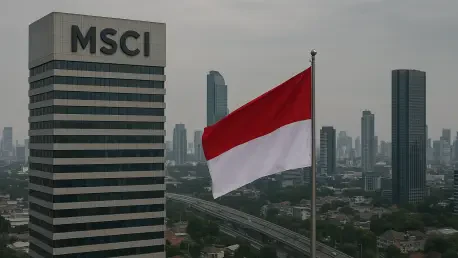

The Shockwave Rattling Jakarta’s Financial Foundations
The Indonesian financial landscape is currently weathering an unprecedented storm, triggered by a stark warning from MSCI that has sent shockwaves through the global investment community. This potential reclassification from “Emerging Market” to “Standalone” status represents a seismic shift that could fundamentally alter how international capital views Southeast Asia’s largest economy. The suggestion that the nation could be downgraded beyond “Frontier” status—a label reserved for markets with severe accessibility issues—has already led to a historic sell-off in Jakarta, leaving regulators and domestic investors in a state of high alert.
The gravity of this situation cannot be overstated, as a Standalone designation typically implies that a market is no longer suitable for most institutional investment mandates. By examining the intersection of domestic policy and international standards, it becomes clear that Indonesia is at a critical juncture where the divide between local practices and global expectations has never been wider. This analysis explores the immediate market reaction, the underlying regulatory concerns, and the broader implications for a nation that has long been a favorite of global index trackers.
Understanding the Stakes of Market Classification
Market classifications by entities like MSCI serve as the primary roadmap for institutional investors, determining where trillions of dollars in global capital are allocated. Historically, Indonesia has been a staple of the Emerging Market index, attracting significant foreign direct investment and passive fund flows that have fueled infrastructure and industrial growth. However, the current scrutiny highlights how fragile this inclusion can be when market structures fail to evolve in tandem with global transparency requirements.
The “Standalone” label is a rare and severe designation, often reserved for markets experiencing extreme political instability or those that fail to meet basic requirements for price discovery and liquidity. This crisis echoes some of the volatility observed during the 1998 Asian Financial Crisis, though the drivers today are more structural than purely speculative. Understanding this historical context is vital, as it underscores the massive economic cost associated with being deemed “uninvestable” by the world’s most influential index provider.
The Catalysts for Instability and Institutional Alarm
The Unprecedented Market Rout and Liquidity Crisis
The immediate impact of the MSCI warning was a historic two-day stock market rout that surpassed the darkest days of previous economic cycles. Jakarta’s benchmark index plummeted, driven by a 15.2% cumulative decline that signaled a mass exodus of foreign capital and a breakdown in domestic confidence. This sell-off was not limited to equities; the Indonesian rupiah neared record lows against the dollar, and government bond yields spiked to 7.4%, reflecting a sharp increase in borrowing costs.
Regulatory Disconnect and the Transparency Gap
A critical point of contention between Indonesian regulators and international bodies is the perceived opacity of the domestic market, particularly regarding ownership structures. MSCI’s scrutiny focuses on the influence of a small group of ultra-wealthy individuals or conglomerates whose dominance on the Jakarta Composite Index distorts price discovery. While the Indonesia Stock Exchange has attempted to implement reforms, global investors view these efforts as insufficient to bridge the “trust deficit” that has formed over several years.
Macroeconomic Pressures Under the New Administration
The timing of this crisis is particularly challenging as it coincides with the early tenure of President Prabowo Subianto, whose fiscal policies are under intense global scrutiny. Investors are closely monitoring the independence of Bank Indonesia and the administration’s commitment to maintaining a stable debt-to-GDP ratio. Goldman Sachs estimates that a total exit from MSCI indexes could trigger $5.6 billion in passive outflows, a figure that does not account for the additional billions in active management funds that would likely follow suit.
Future Projections: The Path Toward Reclassification
The future of Indonesia’s market status hinges on the government’s ability to execute rapid and meaningful structural reforms to satisfy global benchmarks. We are likely to see a shift toward more stringent “free-float” requirements and a crackdown on ownership concentration to ensure that large-cap companies are not controlled by a handful of entities. If the nation fails to provide a clear roadmap for these changes by the start of next year, the transition to a Standalone market could lead to a prolonged period of economic isolation.
Technologically, the Indonesia Stock Exchange may need to modernize its trading platforms to ensure better price discovery and prevent the type of manipulation that MSCI has flagged. Moving beyond 2026, the focus will likely shift to integrating advanced surveillance systems that can detect irregular trading patterns in real-time. This modernization is essential for regaining the confidence of passive fund managers who require highly liquid and transparent environments to justify their allocations.
Strategic Implications for Investors and Policymakers
The primary takeaway from this crisis is that market accessibility and transparency are not optional for nations seeking to participate in the global financial system. For domestic policymakers, the recommendation is clear: prioritize the alignment of local trading rules with international standards, specifically regarding downward price limits and index weighting. Failure to act decisively will likely result in a permanent increase in the cost of capital, hindering the country’s ability to fund essential social and infrastructure projects.
For investors, the current volatility suggests a need for a defensive posture, focusing on companies with high transparency and diverse ownership structures. Real-world application of this data suggests that Indonesia must move beyond “damage control” and toward a fundamental overhaul of its capital market governance. Diversifying away from sectors heavily influenced by concentrated family ownership may provide a hedge against the risks associated with index reshuffling and potential reclassification.
Reflection on Indonesia’s Strategic Financial Shift
The threat of MSCI stripping Indonesia of its Emerging Market status represented the most significant challenge to the country’s financial credibility in decades. The core themes of transparency, ownership structure, and regulatory independence determined whether Jakarta remained a destination for global capital. As the world watched the response of the administration, the long-term significance of this moment became undeniable, highlighting the fragile nature of market trust in an interconnected world.
Indonesia stood at a crossroads where it either embraced rigorous standards or faced the consequences of market isolation. The crisis served as a catalyst for a broader discussion on the necessity of institutional transparency in a competitive international environment. Ultimately, the lessons learned from this period provided a roadmap for other developing nations striving to maintain their standing in the global financial hierarchy. Those who adapted early to these shifting requirements managed to safeguard their portfolios against the volatility that followed.