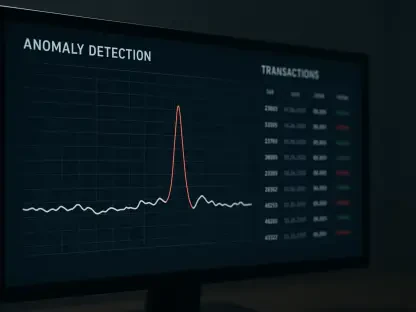

The financial services sector is currently navigating an unprecedented era of digital uncertainty where the traditional boundaries of trust are being systematically dismantled by advanced generative tools. As sophisticated machine learning models become ubiquitous, the concept of a “fog of war” has migrated from the battlefield to the boardroom, creating a landscape where distinguishing between a legitimate client request and a malicious deepfake is nearly impossible for the untrained eye. This technological shift has initiated a relentless arms race between global banking institutions and agile cybercriminal syndicates, both of whom are leveraging the same underlying computational power to achieve opposing ends. For small wealth management firms and multinational conglomerates alike, the strategic calculus of defense has changed because the barrier to executing high-fidelity, deceptive attacks has effectively vanished. This pervasive ambiguity complicates every interaction, forcing a fundamental reassessment of what constitutes a secure transaction in a world where digital evidence is no longer a reliable indicator of reality.
The Proliferation of Synthetic Identity Fraud: A New Digital Frontier
The emergence of synthetic identities represents one of the most significant shifts in the threat landscape, as bad actors now utilize generative adversarial networks to produce highly realistic avatars in mere minutes. Financial advisors, who have long predicated their business models on the sanctity of personal relationships and direct communication, are finding that a client’s familiar voice or face can now be perfectly mimicked by a script. This capability allows attackers to bypass the emotional and visual cues that professionals once used to verify identity during sensitive wire transfers or account changes. When a fraudster can project a live, moving image that responds in real-time to questions during a video call, the traditional “know your customer” protocols are rendered insufficient. The psychological impact of these breaches is profound, as the failure is not merely technical but a direct subversion of the human connection. Modern security platforms struggle to keep pace as detection algorithms often trail behind the latest generative breakthroughs.
Historically, the execution of complex cyberattacks was the exclusive domain of well-funded criminal enterprises, but the current technological environment has democratized these capabilities for everyone. The plummeting cost of computing power and the availability of open-source large language models have effectively subsidized the operational expenses of the modern digital thief. Sophisticated phishing campaigns that once required a team of native speakers to craft can now be generated at scale in seconds, complete with perfect grammar and culturally relevant context. This economic shift means that the return on investment for cybercriminals has skyrocketed, as they no longer need to invest significant resources to achieve a high probability of success. By automating the reconnaissance phase of an attack, hackers can identify vulnerabilities across the entire financial ecosystem with minimal manual intervention. This creates a high-volume, high-frequency threat environment where the sheer number of attempts can overwhelm even the most robust automated filtering systems.
Navigating Response Gaps: Strategic Preparedness and Human Protocols
Modern AI-driven attacks operate at such extreme speeds that the damage is often done before a manual response team can even be mobilized to assess the magnitude of the intrusion. This creates a widening gap between the initial compromise and the implementation of effective countermeasures, leaving systems vulnerable to secondary exploits or lateral movement within the network. Legacy defensive processes, which often rely on human-in-the-loop decision-making, are increasingly mismatched against the automated execution of malicious payloads. This delay in response allows attackers to entrench themselves deeply within a firm’s infrastructure, obfuscating their tracks and making the recovery process significantly more complex. In many cases, firms remain in a state of prolonged uncertainty, unable to confirm whether a threat has been fully neutralized. This is exacerbated by a pivot toward massive data harvesting, where the true cost of a breach is deferred, surfacing only when stolen data is used for secondary attacks months later.
To survive this volatile environment, the industry prioritized human-centric protocols that operated outside the digital realm to verify critical actions and secure sensitive accounts. Organizations established a more resilient posture by integrating structured preparedness frameworks that emphasized rapid impact assessment and clear recovery timelines rather than relying solely on automated detection. They implemented low-tech defenses, such as private verbal PIN codes, providing a vital layer of security that remained unreachable for even the most advanced voice cloning software. Successful firms moved beyond simple perimeter defense to adopt a strategy centered on resource identification and the clear delineation of roles during a crisis. These institutions invested in specialized training that taught employees to recognize subtle psychological manipulation, effectively turning the workforce into a primary line of defense. By documenting every process and establishing offline communication channels, the sector ensured operational continuity even when digital infrastructures were under heavy assault.