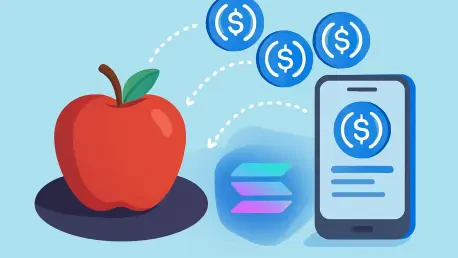

The distribution of USDC dividends to tokenized Apple shareholders on the Solana blockchain marks a critical transition from simple asset trading to the fulfillment of complex corporate economic rights. This development signals that the maturity of blockchain technology now allows it to handle the sophisticated administrative requirements that were once the exclusive domain of legacy financial institutions. By bridging the gap between a public ledger and a multi-trillion-dollar corporation like Apple Inc., tokenization platforms have demonstrated that digital representations of value can carry the same weight as traditional stocks. This integration provides a clear pathway for investors to maintain a single digital identity for all their financial activities, from decentralized finance interactions to long-term equity holdings. As the infrastructure continues to stabilize, the friction between these two historically separate worlds begins to dissolve, paving the way for a more unified financial ecosystem where assets and currency exist on a single ledger.
Operational Alignment: Dividend Synchronization
Securitize meticulously aligned its blockchain-based operations with the official quarterly dividend schedule established by Apple Inc. to ensure parity with the legacy financial system. Following the tech giant’s announcement of a $0.27 per share payout in November 2026, the platform tracked the record and payment dates with precision, allowing token holders to receive their earnings in lockstep with traditional brokerage clients. This synchronization was essential for maintaining investor confidence, as it proved that decentralized systems can reliably interact with the rigid timelines of corporate America without causing delays. While the technological success of this distribution was significant, the current scale revealed a focused pilot phase rather than a mass-market rollout. Data indicated that the total distribution was approximately 43 USDC across 20 distinct wallets, reflecting the infancy of retail participation in tokenized equity markets during this period of early adoption and testing.
The initial distribution metrics highlighted a highly concentrated ownership structure, where a single market maker wallet received the vast majority of the funds to support liquidity for the broader network. With only 160 tokenized Apple shares currently in circulation on the Solana blockchain, the project emphasized the functional validation of the software over immediate volume. Most of the payout was concentrated in a single address that facilitates the buying and selling process, while the remaining balance was distributed among nearly twenty retail participants. These figures serve as a baseline for the industry, demonstrating that the pipes for automated corporate actions are now fully operational and ready for larger inflows of capital. The concentration of assets within market maker accounts provided the necessary stability for future investors to enter the market with the assurance that they could trade their tokenized shares with minimal slippage while receiving their economic rights.
Technical Integration: The Solana Framework
Selecting the Solana network as the primary settlement layer was a strategic decision driven by the need for high throughput and low transaction costs, which are vital for automated dividend payouts. By utilizing smart contracts to process these payments, the platform eliminated several traditional intermediaries like clearinghouses and transfer agents that typically slow down the movement of cash. This streamlined approach allowed for near-instant settlement in USDC, providing a level of efficiency that legacy banking systems struggle to match during peak periods of corporate activity. The success of this infrastructure encouraged a rapid expansion of the tokenized catalog, which grew from an initial dozen offerings to twenty-five different stocks within a short timeframe. This growth suggested a strong institutional appetite for moving traditional financial instruments onto high-performance blockchains that can handle the complexities of real-time asset management and automated accounting.
The operational success of this pilot was anchored in a robust wrapper model where Securitize managed the conversion of traditional US dollars into digital stablecoins for final delivery. Apple paid the official dividend to a regulated custodian in fiat currency, which was then converted and distributed on-chain to verify that all token holders received their rightful economic benefits. This methodology required strict adherence to regulatory standards, including identity verification and complex tax withholding procedures that were integrated into the digital issuance process. As the industry moved forward, this proof of concept positioned the network as a serious contender for the institutionalization of global finance. The focus shifted toward comprehensive wealth management systems where automated reinvestments and instant cross-border payments became the standard expectation, proving that blockchain technology could provide a transparent and reliable foundation for capital markets.
The successful distribution of dividends to digital wallets established a new benchmark for how legacy assets interacted with decentralized infrastructure. This milestone ensured that the economic value of traditional equities was no longer confined to siloed banking systems, allowing for greater mobility and utility of capital. Investors who participated in this phase benefited from a streamlined experience that bypassed the multi-day settlement windows common in standard brokerage accounts. These advancements solidified the role of public blockchains as indispensable tools for the next generation of efficient financial markets, offering a blueprint for the tokenization of thousands of other securities. Future participants looked toward the implementation of fully automated tax reporting and governance voting features, which represented the next logical steps in the complete digital transformation of shareholder rights. This transition effectively bridged the gap between old-world stability and the high-tech efficiency of the modern era.