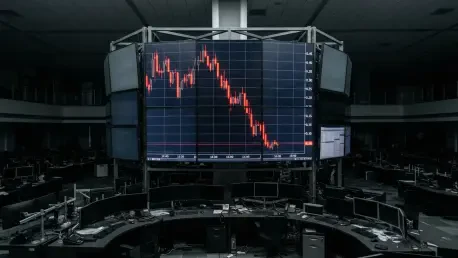

Under current European regulatory frameworks, retail clients trading XRP through contracts for difference are capped at two-to-one leverage to prevent the catastrophic losses often seen on offshore exchanges. This regulatory ceiling serves as a critical buffer during periods of extreme market volatility, such as the current correction that has seen XRP lose approximately 30 percent of its market value since early October. On Wednesday morning, November 11, the digital asset traded around $1.058, representing a notable retreat from the $1.52 peak recorded just weeks prior on October 5. Despite this significant downward trend, the market is witnessing an unusual phenomenon where leveraged buyers are paying record-high fees to maintain their positions. This behavior suggests that a large segment of the trading community remains stubbornly optimistic, expecting a rapid recovery even as the spot price continues to find lower support levels. The discrepancy between the actual price trajectory and the aggressive positioning of futures traders creates a precarious environment where a further drop could trigger a cascade of forced liquidations, potentially pushing the asset toward the psychological floor of $1.00.
1. Analysis of Market Conditions: The Funding Rate Anomaly
The current data highlights an extraordinary situation on the Binance exchange, where the cumulative funding rate for XRP has reached 0.18 percent over a 30-day period. This level of funding represents the highest reading observed since October 2025, a time when market sentiment was markedly different following a period of historic highs. To understand the significance of this metric, one must look at how perpetual futures function as derivatives without an expiration date. These contracts rely on a funding mechanism to ensure their price remains closely aligned with the underlying spot price of XRP. When the funding rate is positive, it indicates that long positions, or those betting on a price increase, are more numerous and are paying a fee to short positions. In a typical bearish cycle, funding rates often turn negative as traders bet on further declines. However, the current persistence of a high positive rate suggests that bulls are either doubling down on every dip or are refusing to exit their trades despite the 30 percent drawdown, creating what analysts describe as a crowded trade that lacks a stable foundation.
Cross-referencing this data with the OKX exchange reveals a similar trend of persistent long-side dominance. Since October 9, the funding rate on OKX has been positive in 76 out of the last 100 settlement periods, which occur every eight hours. This constant outflow of capital from buyers to sellers adds up significantly over time. For instance, a trader holding a $10,000 long position would have paid approximately $39 in funding fees alone over the past month. When combined with the price loss of roughly $2,300 on that same position, the total cost of maintaining the trade becomes a heavy burden. The fact that the long-short ratio on OKX recently peaked at 4.27 indicates that for every trader betting on a decline, there are more than four accounts betting on a recovery. This extreme imbalance often precedes a “long squeeze,” where a minor price drop forces these overleveraged accounts to close their positions simultaneously, creating a wave of selling pressure that can rapidly drive prices down to unexpected levels.
2. Institutional Divergence: ETF Outflows and Open Interest Resilience
While retail and speculative traders appear to be holding onto their bullish outlook, institutional interest in XRP has shown signs of cooling. Recent reports indicate that US-based spot ETFs for XRP experienced net outflows of approximately $10.4 million, which is equivalent to nearly 9.4 million tokens. This movement is particularly noteworthy as it coincides with the first anniversary of the Canary Capital fund, which launched on November 13, 2025. Throughout much of the current year, these funds had maintained a steady stream of inflows, but the recent reversal suggests that larger fund managers and institutional investors may be taking a more cautious approach to the current volatility. In the exchange-traded fund world, an outflow directly translates to the issuer selling the underlying asset on the open market. If this trend of institutional selling persists into the end of November, it could remove a significant source of support that helped maintain XRP’s valuation during the earlier months of the year.
The dynamics of open interest further complicate the market picture. Open interest, which measures the total value of all active futures contracts, stood at $132.1 million on OKX in early November before sliding to roughly $101.9 million by November 10. While a 23 percent decline might seem substantial, it is important to note that a large portion of this decrease is simply due to the lower market price of the asset. When measured in terms of actual coin volume, the number of open positions has only decreased by about ten percent. This indicates that a vast majority of traders are “holding the line” and refusing to liquidate their positions despite the price moving against them. Such resilience can be a double-edged sword; while it prevents an immediate collapse, it also means that the market has not yet undergone the “cleansing” of leverage that usually marks the bottom of a correction. Without a significant reduction in these open contracts, the potential for a sudden, volatile exit remains a primary risk for the asset’s short-term price stability.
3. On-Chain Mitigation: The Exhaustion of External Selling Pressure
Amidst the volatility in the derivatives market, a significant source of external selling pressure appears to be nearing its end. On-chain data from the XRP Ledger shows that the wallets associated with the late 2025 Binance security breach are finally being emptied. Specifically, in validated ledger 108,255,241, the funds from a wallet that had previously held over 33 million XRP were moved in their entirety to a collection address used by the attacker to distribute the loot in smaller tranches. As of Wednesday morning, only about 29.5 million tokens remain in this collection wallet, representing a small fraction of the 233 million XRP originally stolen. The attacker has been utilizing services like THORChain to swap these funds into Bitcoin, a process that has placed a consistent but manageable drag on the XRP price for several weeks. With approximately 87 percent of the stolen assets already processed, the market is approaching a point where this specific source of forced selling will no longer influence the price.
The rate at which these stolen funds are being moved suggests that the remaining balance could be exhausted within a matter of days. Since Tuesday, the attacker has been transferring tokens in tranches with a median size of 127,000 XRP. While the total volume of nearly 30 million tokens might seem large, it is relatively small when compared to the global daily trading volume of over $2.3 billion. The removal of this persistent seller provides a potential silver lining for those looking for a price floor. Once the “Binance attacker” factor is completely resolved, the market will only have to contend with organic supply and demand dynamics rather than the artificial pressure of a liquidating exploiter. This transition could allow the ledger’s natural utility and holder sentiment to play a more dominant role in price discovery as the market moves into the final weeks of November.
4. Market Scenarios: Support Levels and Macroeconomic Influences
Navigating the remainder of the month requires a clear understanding of the key technical levels currently in play. Analysts have identified a “weak case” scenario where a break below the recent daily low of $1.034 could see the price slide toward the psychological support level of $1.00. This zone is particularly significant because it served as a major floor during the trading cycles seen in August 2026. A breach of this level would likely trigger a massive wave of forced liquidations in the futures market, as many traders have their exit thresholds set just below the round number. Conversely, a “base case” scenario suggests that XRP could spend the coming weeks consolidating between $1.03 and $1.10. This sideways movement would allow the funding rate to naturally cool down without requiring a catastrophic price drop, as traders gradually lose patience and close their high-cost positions in favor of more stable assets.
External factors, particularly from the broader financial landscape, will also heavily influence the asset’s trajectory. The broader crypto market, led by Bitcoin trading near $73,700, remains sensitive to shifts in US monetary policy. Following recent inflation data, market participants are once again pricing in the possibility of a rate hike at the Federal Reserve’s next meeting, scheduled for December 9, 2026. Higher interest rates typically reduce the appetite for high-risk assets like cryptocurrencies, which could put additional pressure on XRP. For a “strong case” recovery to $1.16 or higher to materialize, the market would likely need to see a return of positive ETF inflows and a stabilization of the global macroeconomic outlook. If XRP can reclaim the $1.10 level and hold it through the middle of the month, it may signal that the worst of the current correction has passed and that the market is ready to test higher resistance zones near $1.27.
5. Portfolio Management: Protecting Assets in High-Risk Environments
The market landscape through November proved to be a challenging environment for leveraged participants who faced significant headwinds from both price action and maintenance costs. Historically, investors who prioritized direct ownership over speculative derivatives found themselves in a more resilient position during these periods of extreme volatility. By choosing to buy XRP directly on spot markets, these participants eliminated the constant drain of funding fees and the threat of automated liquidation that plagued futures traders. This approach was particularly effective in jurisdictions like Germany, where the legal framework allowed for tax-exempt gains on digital assets held for more than one year. For those who navigated the 30 percent correction, the strategic shift toward long-term holding provided a level of psychological and financial security that was unavailable to those utilizing high leverage on offshore platforms.
Effective portfolio management in the current climate required a disciplined approach to transaction logging and risk assessment. Maintaining precise records of every purchase date and entry price was not merely a matter of organization but a necessary step for navigating complex tax obligations and identifying long-term capital gains opportunities. As the market moved toward the end of 2026, the use of specialized crypto tax software became an industry standard for automating these calculations and ensuring compliance with evolving regulatory standards. Furthermore, institutional shifts and the stabilization of on-chain activity suggested that moving forward, a focus on fundamental indicators rather than speculative hype would be the primary driver of sustainable portfolio growth. Investors who successfully adapted to these conditions by lowering their leverage and documenting their trades positioned themselves to better withstand future market fluctuations.