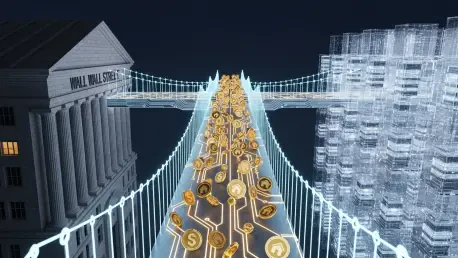

The global financial ecosystem is currently witnessing a fundamental paradigm shift as established Wall Street institutions increasingly adopt blockchain infrastructure to securitize and manage real-world assets more efficiently. This transition is not merely a technical upgrade to existing ledgers but a complete reimagining of how ownership and value are transferred across international borders in a digital-first economy. By converting tangible assets such as real estate, government bonds, and private equity into digital tokens on a blockchain, the industry is effectively bridging the gap between legacy financial protocols and decentralized technology. This synthesis promises to unlock trillions of dollars in stagnant or illiquid capital, providing a level of accessibility and transparency that was previously unattainable within traditional frameworks. As these digital representations of value become standardized, the friction associated with cross-border transactions and asset management continues to diminish, paving the way for a more integrated global market that operates with unprecedented speed and security.
Modernizing Asset Management and Market Participation
Overcoming Operational Friction in Traditional Finance
Historically, traditional financial markets have been hindered by antiquated systems characterized by heavy paperwork, numerous intermediaries, and lengthy settlement times that often span several business days. These legacy frameworks often restrict participation to large institutional players, leaving retail investors with limited access to high-value assets due to steep entry requirements and significant geographic limitations. Tokenization addresses these barriers by representing ownership through programmable digital tokens, allowing the financial industry to bypass these traditional bottlenecks and streamline the management of diverse asset classes. By utilizing distributed ledger technology, firms can now automate much of the administrative burden associated with asset lifecycle management, including dividend distributions and corporate actions. This shift toward automation not only reduces the risk of human error but also significantly lowers operational costs for asset managers and custodians alike.
Expanding Market Accessibility and Asset Liquidity
By enabling fractional ownership, tokenization allows an investor to buy a small portion of an otherwise prohibitively expensive asset, which significantly increases market depth and improves price discovery across various sectors. This democratization of finance ensures that assets are valued more accurately through broader participation, effectively breaking down the entry barriers that have long defined legacy markets. As a result, capital can circulate more freely, providing investors with unparalleled flexibility in how they build and manage their portfolios in an increasingly volatile environment. Furthermore, the ability to trade these fractions on secondary markets provides a level of liquidity that was once impossible for assets like commercial real estate or fine art. This newfound liquidity transforms stagnant capital into active, working assets that can be leveraged or liquidated with minimal slippage. Consequently, the distinction between liquid and illiquid asset classes is becoming increasingly blurred as the technology matures.
Integrating Real-World Assets Into Digital Ecosystems
Institutional Adoption and On-Chain Security Measures
The current landscape is defined by significant institutional adoption, with major entities like J.P. Morgan and BlackRock leading the charge through the deployment of permissioned and public blockchain solutions. These organizations have recognized that blockchain provides a robust and immutable audit trail, which is essential for maintaining trust in high-stakes financial transactions. By integrating real-world assets into digital ecosystems, these firms are setting new standards for security and transparency that surpass the capabilities of traditional centralized databases. Moreover, the emergence of clear regulatory frameworks in major jurisdictions has provided the legal certainty necessary for widespread institutional participation. This regulatory clarity allows for the seamless integration of identity verification and anti-money laundering protocols directly into the smart contracts governing the tokens. As a result, compliance is no longer a reactive process but a proactive, native feature of the digital asset itself.
Navigating Regulatory Evolution and Future Strategy
The industry successfully moved toward a paradigm where 24/7 global markets and atomic settlements became the standard for sophisticated investors and retail participants alike. This evolution allowed for the creation of programmable investment vehicles that automatically managed distributions and rebalanced portfolios based on real-time market data. Financial institutions that prioritized the integration of these technologies secured a competitive advantage by offering lower fees and greater transparency to their clients. Moving forward, it remains critical for market participants to diversify into tokenized treasuries and private credit to capture yields that were previously inaccessible or inefficient to manage. Organizations should also focus on evaluating the robustness of smart contract audits and the interoperability of different blockchain networks to ensure long-term stability. By adopting these strategies, investors positioned themselves to capitalize on the next wave of financial innovation that continued to bridge the divide between legacy finance and the digital age.