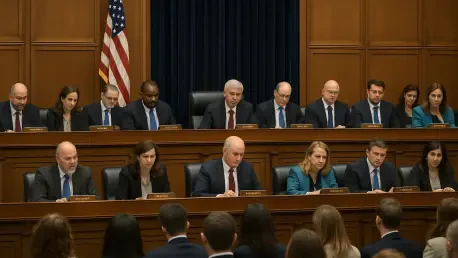

The financial landscape for millions of American workers is undergoing a seismic shift as lawmakers finally move to address the regulatory ambiguity surrounding earned wage access programs. On July 1, 2026, the House Financial Services Committee took a decisive step by approving a federal framework intended to centralize the oversight of these rapidly growing financial services. For years, the industry operated in a gray area, where the lack of a unified definition led to constant friction between technological innovation and traditional consumer protections. This legislative movement seeks to clarify whether these products, which allow employees to tap into wages they have already earned before the scheduled payday, should be categorized as traditional credit or a distinct category of financial health tools. By establishing a federal baseline, the committee aims to replace the current web of conflicting state mandates with a single, predictable standard that provides clarity to providers while ensuring that workers have safe, low-cost alternatives to predatory lending.
Defining Market Models: The Push for Uniform Federal Rules
To grasp the magnitude of these legislative changes, it is necessary to distinguish between the two primary delivery mechanisms that define the current earned wage access market. The employer-integrated model functions as an extension of a company’s payroll system, utilizing actual time-tracking data to verify precisely how much an employee has earned before facilitating a transfer. In contrast, the direct-to-consumer model operates independently of the employer, often relying on historical bank data or estimated earnings to provide liquidity to the user. The federal bill introduced in 2026 attempts to bridge these differences by creating a specific legal classification for all earned wage access products. By defining these services as a unique financial offering rather than a standard loan, the government seeks to remove the threat of usury laws that were never designed for non-recourse wage advances. This categorization is vital for fintech firms that require a stable legal foundation to design and distribute their tools.
Establishing uniform standards across the country serves as the cornerstone of the proposed federal framework, addressing the logistical nightmares faced by national providers. A pivotal component of this legislation is the doctrine of state preemption, which would effectively prevent individual states from imposing their own contradictory rules on products that meet the federal criteria. For financial technology companies, this means they no longer have to navigate a fragmented environment where the rules of the road change every time they cross a state line. Maintaining fifty separate compliance departments to manage varying disclosure requirements and fee caps is a massive financial burden that often translates into higher costs for the end user. By streamlining these regulations into a single national protocol, the bill aims to lower the barrier to entry for new competitors. This competitive environment is expected to drive down fees and encourage the development of more sophisticated features that prioritize the financial wellness of the employee.
Regulatory Conflicts: Reconciling State Autonomy and Federal Oversight
The current legal environment for early wage access is defined by a confusing patchwork of state-level regulations that often contradict one another. Some progressive jurisdictions, such as Missouri and Nevada, have established safe harbor provisions that explicitly state earned wage access is not a loan, provided the service remains non-recourse and follows specific fee disclosures. However, other states like California and Connecticut have moved in the opposite direction, attempting to reclassify these providers as traditional lenders to bring them under strict licensing and interest rate caps. This inconsistency creates a significant amount of legal risk for companies that wish to offer their services to a nationwide workforce. Without a federal anchor, a company might find its business model perfectly legal in one city while being threatened with heavy fines and cease-and-desist orders just a few miles away in a neighboring state. This volatility has historically stifled long-term investment in the sector.
This legislative push has ignited a profound ideological debate in Washington regarding the balance between federal authority and state-level consumer protection. Supporters of the bill argue that a single federal standard is the only way to foster the level of innovation required to provide modern workers with flexible financial tools. They contend that the speed of the digital economy requires a regulatory structure that matches its pace, rather than the slow and localized processes of individual state legislatures. Conversely, critics of the federal approach express concern that centralized rules might dilute the stronger protections established by certain states. They argue that states should retain the right to set stricter rules if they believe specific products are masquerading as helpful tools while carrying hidden risks similar to payday loans. This tension highlights a broader struggle to define how financial technology should be governed when it does not fit neatly into the traditional boxes of banking or consumer credit.
Industry Stabilization: Strategic Implications for the Financial Sector
If this federal legislation reaches final approval, it will provide the clarity necessary for fintech companies to aggressively expand their operations without fear of retroactive legal action. This regulatory certainty acts as a green light for venture capital and institutional investment, which has previously been cautious due to the threat of state-level crackdowns. For fintech startups, the ability to build a product once and deploy it across all fifty states is a game-changer for scalability and profit margins. Beyond just growth, federal recognition helps these companies build trust with traditional financial institutions, potentially leading to more integrated partnerships between neo-banks and legacy lenders. As the industry matures under a federal eye, we are likely to see a shift toward more transparent pricing models and the inclusion of financial literacy tools within the apps themselves. This evolution will likely turn earned wage access from a niche alternative into a foundational pillar of the modern digital banking experience.
For the American workforce and their employers, a formal federal law would provide a much-needed end to the era of regulatory whiplash experienced at the hands of the Consumer Financial Protection Bureau. In recent years, the agency’s interpretation of how existing laws apply to wage access has shifted dramatically based on the political party in control of the executive branch. This oscillation made it nearly impossible for human resources departments to confidently include these services in their benefits packages, fearing future liability. A permanent statutory framework passed by Congress would supersede these temporary agency opinions, ensuring that the rules remain consistent regardless of who sits in the White House. Employers would then be able to view earned wage access as a standard, safe recruitment and retention tool, much like a traditional retirement plan or health insurance. This stability is essential for the long-term health of the labor market, as it allows both companies and workers to plan their financial futures with confidence.
Strategic Integration: The Path Toward Future Financial Stability
The legislative transition toward a federal oversight model for earned wage access successfully laid the groundwork for a more resilient financial ecosystem. By standardizing the definitions and operational requirements for these services, lawmakers provided a clear roadmap that allowed the industry to move past its early phase of legal uncertainty. Companies that proactively aligned their internal compliance structures with the new federal benchmarks were the ones that most effectively captured market share during this period of transition. This shift demonstrated that while state autonomy remains a valued part of the American legal system, the interconnected nature of modern payroll and digital finance required a unified national response. The move toward preemption was a necessary trade-off to ensure that workers in every state had access to the same level of protection and the same variety of financial options. Strategic leaders in the fintech space recognized that the end of the patchwork era was not a restriction on their business, but rather a catalyst for sustainable growth and institutional legitimacy.
Moving forward, the focus for stakeholders shifted toward the integration of these tools into broader financial health platforms that prioritized the long-term stability of the consumer. Financial institutions and employers alike realized that providing early access to wages was only one part of the equation, leading to the development of automated savings and budgeting features that worked in tandem with wage advances. The passage of the bill served as a signal that the era of “move fast and break things” in the wage access space had concluded, replaced by an era of documented accountability and transparent communication with regulators. Organizations that embraced this shift found themselves better positioned to weather economic shifts and build lasting relationships with a loyal user base. Ultimately, the federal framework acted as a stabilizer that encouraged the industry to innovate within a defined set of boundaries, proving that clear rules are often the best fuel for technological progress. The lessons learned during this regulatory overhaul now serve as a template for how other emerging financial technologies can be integrated into the national economy.