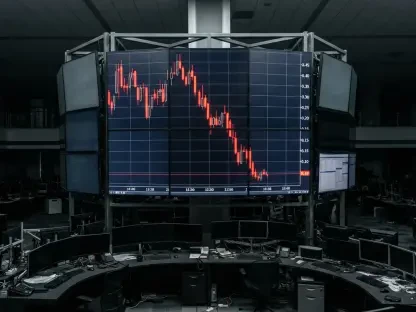

The global landscape for mergers and acquisitions has shifted from an aggressive record-breaking sprint to a cautious, rhythmic crawl that forces dealmakers to navigate a climate defined by extreme volatility and a sudden freeze in mega-deals. In this era of fluctuating interest rates and intensifying geopolitical friction, the core mechanics of corporate expansion are being rewritten. Corporations and private equity firms have begun recalibrating strategies to prioritize resilience over rapid scaling.
This analysis examines the dramatic surge and subsequent cooling of deal activity across various sectors. It evaluates regional performance shifts and incorporates expert sentiment on market repricing while forecasting the role of private equity and AI. Understanding these dynamics is vital for capturing how the financial world responds to structural changes throughout 2026.
The State of Global Dealmaking: Volatility and Volume
The market reflects a period where record-high valuations met institutional hesitation. While the opening months saw a 28% increase in deal value reaching $3.9 trillion, momentum stalled by the third quarter. This volatility created a landscape where volume plummeted by 41% as investors waited for stable economic signals.
Corporate leaders moved toward a strategy of “fewer, larger deals” to maintain market presence without overextending resources. Despite the cooling trend, 122 transactions valued over $5 billion prevented total stagnation. The balance between volume and individual deal value is now the primary metric for gauging the health of global trade.
Statistical Landscape: The Surge and the Slump
Data reveals a “mega-deal freeze” as transactions over $10 billion dropped from 26 in the second quarter to just ten. This slump brought total deal counts to 2020 levels, illustrating a cautious approach by major boards. The reduction in high-value activity signaled a broader shift in risk tolerance among financiers.
Mid-to-large-cap activity provided essential liquidity and confidence. This juxtaposition of declining total counts and stable activity suggests a selective investment environment. Dealmakers are now focusing on high-quality assets rather than pursuing volume-based growth in an uncertain fiscal climate.
Market Applications: Regional and Sector Shifts
The United States reached an all-time high of $2 trillion in year-to-date M&A activity. This performance stood in contrast to other regions, highlighting the strength of American financial infrastructure. While domestic growth remained a priority, these deals influenced global valuation benchmarks.
In Europe, consolidation emerged within the industrial and energy sectors as firms sought to strengthen supply chains. Conversely, Japan experienced a 40% decline in targeted M&A but saw record corporate bond issuance. Sector-specific slowdowns were most visible in technology and industrials, where activity levels were slashed by half during the last quarter.
Expert Perspectives on Market Repricing and Risk
Experts argue that hesitation stems from unclear interest rate trajectories and geopolitical risks. These factors forced a transition from high-growth strategies to value stabilization. Consequently, the industry viewed the current climate as a “repricing” period rather than a retreat.
Banking fees remained robust at $117 billion, suggesting that the underlying architecture is functioning. This stream of revenue indicates that while deal counts are lower, the complexity of ongoing work remains high. Corporate confidence is being tested by the need to find equilibrium without cheap capital.
Future Outlook: Indicators of a Potential Rebound
Private equity firms will serve as a catalyst, with sponsor-backed deals hitting $891 billion. This dry powder represents a significant reservoir of capital waiting for the right conditions. As factors stabilize, these firms will likely lead in revitalizing the deal pipeline.
Potential high-profile IPOs from AI leaders like OpenAI and Anthropic could stimulate the landscape. These events are anticipated to trigger strategic acquisitions within the tech sector. Whether 2026 ends with record volumes depends on the stabilization of macroeconomic indicators.
Navigating a Shifting Financial Horizon
The movement toward fewer but larger deals signaled a fundamental maturation of the financial ecosystem. Decision-makers recognized that the strategic deployment of dry powder and AI-driven transactions offered a path through structural changes. This shift emphasized that corporate agility was a necessity for survival.
The landscape favored those who integrated advanced risk-assessment tools to mitigate shifting interest rates. Institutions that navigated the repricing phase positioned themselves for the next cycle of growth. The market demonstrated that while volatility was high, the infrastructure supported long-term resilience.