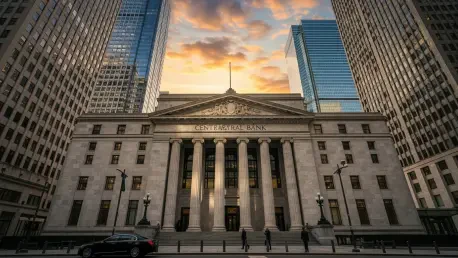

The global financial community finds itself at a precipice as the stewardship of the world’s most powerful central bank undergoes a transformation that could redefine monetary policy for a generation. While leadership changes at the Federal Reserve are traditionally viewed as orderly successions of technocratic expertise, the impending handoff from Jerome Powell to Kevin Warsh carries implications that extend far beyond the mahogany halls of the Eccles Building. This transition arrives at a moment of profound geopolitical realignment and persistent inflationary undercurrents, forcing market participants to question whether the bedrock principle of central bank independence can survive the mounting pressures of an increasingly polarized political landscape. As the transition unfolds, the stakes involve not just the direction of interest rates, but the very credibility of the dollar-denominated global order that has underpinned international commerce for decades. The Federal Reserve has long been viewed as a technocratic body that remains insulated from the short-term pressures of partisan politics, yet the current transition is testing this long-standing autonomy as the selection of a new Chair becomes increasingly entangled with executive branch goals and specific political ideologies.
A Shift in Institutional Leadership
Policy Integrity and Potential Political Pressures
Kevin Warsh enters this role carrying a complex legacy that has invited both admiration from fiscal hawks and skepticism from those who prioritize institutional consistency over political alignment. Throughout his career, Warsh has demonstrated a capacity for shifting his economic perspectives in ways that critics argue mirror the prevailing political climate of the time, leading to concerns about his future independence. His narrow confirmation process in the Senate served as a barometer for this unease, reflecting a deep-seated divide over whether his leadership will prioritize the Fed’s dual mandate or cater to the immediate economic desires of the executive branch. Historically, the Chair is expected to act as a shield against short-term political whims, yet Warsh’s past advocacy for specific interest rate adjustments during periods of executive pressure has raised red flags for those who value the long-standing tradition of a truly autonomous central bank. This skepticism is compounded by the fact that the Federal Reserve must now manage a fragile recovery while resisting the gravitational pull of a government that is increasingly eager to see lower borrowing costs to fund expansive domestic programs.
Structural Changes and Evolving Market Regimes
This leadership pivot is occurring simultaneously with two distinct and powerful regime changes that are reshaping the American economic landscape in real-time. The first is a clear political shift, where the executive branch is seeking a more direct hand in crafting monetary policy to ensure it complements a broader agenda of industrial protectionism and domestic expansion. The second is a structural departure from the Great Moderation, an era characterized by predictable inflation and low volatility that defined the early decades of the twenty-first century. As we navigate the period from 2026 to 2028, the Fed must contend with a world where the old rules of engagement no longer apply, and the search for a new equilibrium requires a leader who can balance these competing forces without sacrificing price stability. The definitive end of this stable era means that the foundations of global finance are being rebuilt under much more unpredictable conditions, where the traditional models used to forecast economic outcomes are becoming increasingly obsolete in the face of rapid technological shifts and changing trade dynamics.
Strategic Safeguards and Institutional Continuity
Jerome Powell’s response to this impending transition has been historically significant, as he has signaled an intention to remain on the Federal Reserve’s Board of Governors even after his term as Chair concludes. This strategic decision is widely interpreted by market analysts as a deliberate attempt to safeguard the institution’s integrity against excessive political interference and the potential for disruptive external management investigations. By maintaining his presence within the Fed’s inner circle, Powell aims to provide a stabilizing influence that ensures the central bank’s traditional role is not entirely undermined by shifting political winds. This move creates a unique power dynamic where an outgoing Chair remains a voting member, potentially acting as a check on any radical policy shifts that the new leadership might attempt to implement. It serves as an insurance policy for institutional memory and professional continuity in a time of deep uncertainty, reminding the world that the Fed’s core mission should transcend the personality of whoever happens to hold the gavel.
Global Macroeconomic Consequences
Stability Transitions and Price Volatility
The era of predictably cheap credit and low inflation has definitively drawn to a close for the developed world, ushering in a period of heightened sensitivity to any movement made by the Federal Reserve. Because the Fed’s decisions exert a massive gravitational pull on global markets, a shift toward a less predictable or more politically influenced policy regime could create a domino effect across international borders. Investors who once relied on transparent forward guidance now face a landscape where interest rate trajectories are subject to sudden shifts based on shifting political priorities rather than pure economic data. This rise in volatility is not merely a technical challenge for traders but a systemic risk that threatens the stability of long-term capital investments, as the cost of borrowing becomes a moving target. As the central bank recalibrates its approach to inflation, the global economy must adjust to a higher-for-longer interest rate environment that challenges the solvency of highly leveraged entities and alters the calculus for infrastructure projects and technology investments.
Emerging Markets and Dollar Sensitivity
Emerging markets are particularly vulnerable to these shifts in U.S. monetary policy, as they often rely on stable dollar liquidity to service debts and attract foreign investment. If the Powell-Warsh transition results in erratic policy signals, the resulting capital outflows from developing nations could trigger a series of sovereign debt crises and localized economic collapses. These nations often lack the fiscal buffers to withstand sudden spikes in the value of the dollar or rapid increases in international borrowing costs, making the Fed’s perceived independence a matter of survival for their economies. In this context, the transition is not just a domestic American affair but a global event that dictates whether small and medium-sized economies can maintain their growth trajectories or be forced into defensive austerity measures. The interconnectedness of the modern financial system ensures that a policy mistake in Washington is felt in the streets of Jakarta and Brasilia, highlighting the immense responsibility that rests on the shoulders of the incoming leadership to maintain a steady hand.
Structural Shocks and Global Inflation
Structural changes in the global economy have ensured that supply chain shocks are no longer temporary anomalies but rather a permanent feature of the modern industrial landscape. Geopolitical conflicts in key regions, coupled with evolving tariff regimes and disruptions in major shipping lanes, have created a new normal of supply-side volatility. This environment makes the task of managing inflation significantly more difficult, as traditional monetary tools are often ineffective against cost-push factors that originate far outside the central bank’s direct control. Central bankers must now operate in a world where the production costs of essential goods can skyrocket overnight, requiring a level of agility and foresight that goes beyond the standard econometric models used in previous decades. These ongoing structural shocks have forced international peers, such as the Reserve Bank of Australia, into a perpetually defensive posture. As they react to the external pressures generated by U.S. policy, these institutions find it increasingly difficult to chart an independent course that serves their own domestic interests.
Managing the International Financial Order
Institutional Trust and Crisis Management
The stability of the modern international financial system relies heavily on a foundation of trust and coordination between the world’s major central banks, a bond that was forged in the fires of the 2008 financial crisis. During that era, the Fed acted as a lender of last resort not just for the United States, but for the global banking system, providing critical liquidity through swap lines and other emergency measures. For this system to function during future panics, the Chair of the Federal Reserve must be viewed as a credible, independent actor whose primary loyalty is to systemic stability rather than partisan advantage. If the international community begins to perceive the Fed as an arm of the executive branch, the cooperative spirit that allows for swift action in times of crisis will inevitably vanish, replaced by a fragmented and suspicious environment. This erosion of trust would make it nearly impossible to coordinate the massive, multi-national interventions necessary to halt a contagion, potentially leading to a more prolonged and damaging global economic downturn.
Politicized Tools and Strategic Vulnerabilities
There is a growing and justified concern that technical financial tools, such as foreign exchange swap lines and repo facilities, could become bargaining chips in broader political negotiations. If these mechanisms, which are essential for stabilizing global dollar markets, become tied to diplomatic concessions or are brought under the tighter control of the Treasury Department, the integrity of the global financial architecture will be at severe risk. The upcoming years will serve as a crucial trial for the Federal Reserve as it attempts to manage high inflation and recurring fiscal crises while resisting the gravitational pull of partisan politics. The risk is that the technocratic shield that has protected the global economy from short-term political manipulation for decades is being dismantled, leaving the international financial order vulnerable to the same polarization that has already paralyzed other major institutions. Maintaining the neutrality of these technical tools is not just a matter of financial efficiency; it is a prerequisite for the continued functioning of the global trade system.
Future Resilience and Actionable Adaptations
To mitigate the risks associated with this leadership transition, institutional investors and sovereign wealth funds prioritized diversifying their currency exposure and increasing holdings in non-correlated assets. Policymakers in other nations also accelerated the development of regional liquidity backstops and independent settlement systems to reduce their over-reliance on the Federal Reserve’s discretion. Ultimately, the transition from Powell to Warsh represented a defining moment for the resilience of the global financial system during a period of intense structural change. While the immediate focus remained on interest rate decisions, the deeper significance of the move lay in its impact on the perceived independence of the Federal Reserve. By the conclusion of this period, it was clear that the successful navigation of global finance required more than just technical expertise; it demanded a renewed commitment to the institutional norms that kept monetary policy separate from the short-term cycles of governance. This shift necessitated a fundamental re-evaluation of how international stability was maintained.