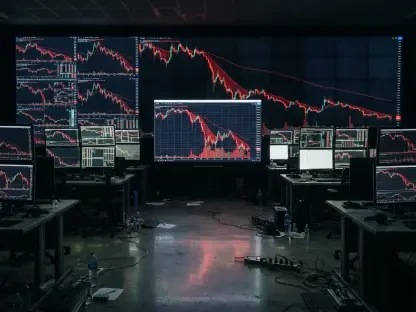

Statistical analysis reveals a negligible negative correlation of zero point zero six between Bitcoin price movements and the performance of Chinese AI stocks. This divergence underscores a broader narrative of market fragmentation currently unfolding in the global financial landscape. While digital assets have managed to chart an independent course, the Chinese artificial intelligence sector is undergoing a painful correction that has seen the STAR50 index shed nearly forty percent of its value in a matter of months. This rapid erosion of nearly five hundred billion dollars in market capitalization serves as a sobering reminder of the volatility inherent in speculative technology surges. The downturn was precipitated by a combination of unsustainable price-to-earnings multiples and increasingly restrictive international trade policies that have hampered domestic semiconductor production. As retail investors and state-backed funds grapple with the fallout, the question of whether this collapse remains a localized incident or acts as a catalyst for a wider global contagion is dominating discussions among institutional strategists worldwide.
Resilience of Western Markets and Risk Factors
Structural Disparities: Valuation and Profitability
The divergence between Eastern and Western technology markets is primarily rooted in the fundamental quality of earnings and the sustainability of current valuation frameworks. Even after the recent precipitous decline, many Chinese AI firms continue to trade at multiples that exceed one hundred times their trailing earnings, reflecting a market still saturated with speculative fervor despite the correction. In contrast, the Nasdaq 100 in the United States maintains a more grounded valuation profile, supported by robust cash flows and clear paths to monetization for generative AI services. This massive valuation gap provides a structural buffer for American equities, shielding them from the direct fallout of the Chinese sell-off. While the Philadelphia Semiconductor Index has recently dipped into technical bear market territory, this movement appears more indicative of a necessary cooling period rather than a systemic failure. The inherent profitability of Western hardware giants allows them to absorb macro shocks that would otherwise dismantle firms operating solely on projected growth.
Market Milestones: Investor Confidence and IPO Trends
Looking ahead, several high-profile events will serve as critical litmus tests for the endurance of the global AI investment thesis. The upcoming initial public offering of Anthropic and the subsequent quarterly earnings reports from major hyperscalers are expected to define the narrative for the remainder of the year. These milestones will indicate whether the massive capital expenditures currently being funneled into data center infrastructure are beginning to yield the expected productivity gains. If these industry leaders can demonstrate consistent revenue growth tied directly to AI integration, the current skepticism surrounding a potential bubble may dissipate. However, if growth stalls or margins begin to compress under the weight of immense operational costs, the pressure on valuations will likely intensify. Market participants are also keeping a watchful eye on Federal Reserve policy shifts, as any unexpected pivot in interest rates could drastically alter the discounted cash flow models used to justify the premium prices of high-growth technology stocks across the board.
Cryptocurrency Performance and Technical Outlook
Asset Independence: Decoupling and Niche Token Volatility
The relationship between traditional equity markets and the cryptocurrency sector has undergone a significant transformation during this period of Chinese market instability. While semiconductor leaders in Asia saw their valuations slashed by half, Bitcoin demonstrated a surprising degree of resilience, often moving in the opposite direction of distressed equity indices. This decoupling suggests that a growing segment of the investment community views Bitcoin as a sovereign asset class, functioning as a hedge against regional financial instability rather than a correlated risk asset. However, this independence does not extend to the entire digital asset spectrum. AI-themed tokens and decentralized compute protocols continue to exhibit a high degree of sensitivity to the broader technology narrative. Assets such as Bittensor and Render have experienced amplified volatility, often tracking the movements of the Nasdaq 100 more closely than Bitcoin itself. This divergence highlights a split where the primary store of value remains stable while speculative niche tokens remain tethered to the shifting fortunes of the global tech sector.
Technical Analysis: Support Levels and Strategic Considerations
Technically, the current positioning of leading digital assets suggests a period of intense consolidation as markets digest recent macroeconomic data. Bitcoin is presently fluctuating near the seventy-nine thousand five hundred dollar mark, a level that has become a focal point for both short-term traders and long-term holders. The asset is hovering just below its fifty-day Exponential Moving Average, an indicator that often signals a shift in mid-term momentum. A failure to reclaim this average could lead to a retest of major support floors around the seventy-nine thousand two hundred dollar level, which has historically acted as a psychological and technical barrier. Conversely, a strong close above immediate resistance could invalidate the current bearish tilt and set the stage for a push toward new all-time highs. This technical tug-of-war is taking place against a backdrop of shifting institutional inflows, as the introduction of spot-based exchange-traded funds has altered the liquidity profile of the market, making it more sensitive to traditional financial cycles.
Strategic Outlook: Navigating the Post-Bubble Landscape
The dramatic correction in the Chinese AI market provided a definitive roadmap for how speculative bubbles eventually deflate when faced with the harsh reality of trade restrictions and overvaluation. While the immediate financial impact was concentrated within Asia, the lessons learned from this episode resonated across global trading floors. Investors who prioritized fundamental earnings over hype were able to preserve capital, while those who chased parabolic moves in the STAR50 index faced significant losses. The decoupling of Bitcoin from this regional crisis proved that digital assets could maintain their utility as independent hedges in a fragmented world. To prepare for the next phase of market evolution, market participants shifted their focus toward sustainable growth models and diversified their holdings to mitigate regional geopolitical risks. Looking ahead, the emphasis remained on monitoring the core profitability of U.S. technology leaders and the technical health of major support levels. By adopting a more disciplined investment strategy, the global community moved past the era of unfettered speculation toward a more stable integration of artificial intelligence.