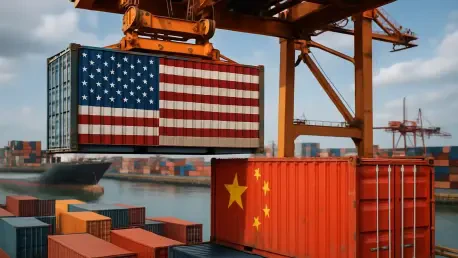

Kofi Ndaikate has spent years navigating the complex machinery of global finance and trade, establishing himself as a sharp observer of the friction between political policy and economic reality. As a seasoned expert in the Fintech and blockchain space, he understands that the digital and physical flows of commerce often tell two different stories. Today, he joins us to peel back the layers of the ongoing trade tensions between the United States and China, examining how global supply chains are adapting to a new era of tariffs and rhetoric. We dive into the surprising resilience of these economic ties and why the headline figures of a “decoupling” might be more of a geographic shell game than a true separation of industry.
Direct trade between the U.S. and China has dropped by 20% in 2025, leading many to believe that the two giants are finally drifting apart. How are Asian intermediaries quietly absorbing this shock and maintaining the flow of goods?
It is a fascinating shell game that masks the true state of global commerce. While direct exports from China to the United States fell by 20% in 2025, that volume didn’t simply vanish into the ether; it was offset by a massive 30% surge in U.S. imports from other Asian economies like Vietnam, India, and Thailand. At the same time, Chinese exports to those very same regional neighbors rose by 12%, which clearly shows a rerouting of the supply chain rather than a total break. This pattern strongly implies that a significant portion of goods destined for American living rooms continues to originate within Chinese production networks, simply passing through a regional middleman to avoid the heat of direct tariffs. It creates a resilient, if slightly more expensive, bridge that keeps the two economies intertwined despite the political friction.
Electronics seem to be the primary battlefield in this trade shift, making up 60% of the reduction in bilateral trade. How do hubs like Vietnam function in this ecosystem, and does the “value added” still lead back to Chinese industry?
Electronics are the nerve center of this conflict, particularly computers, smartphones, and telecommunications equipment, which are the most exposed categories. When you look at an assembly hub like Vietnam, it might look like a new manufacturing powerhouse on paper, but the reality is that these facilities remain heavily reliant on China for advanced components and raw materials. Even if the final export origin is no longer listed as China, the high-value engineering and industrial muscle continue to flow from Chinese factories. In essence, the map of commerce is being reshaped, but the fundamental question of who actually makes the parts remains unchanged. It is a surface-level fragmentation that allows for political victories while keeping the actual industrial ties as tight as a drum.
With the U.S. now sourcing 23% of its foreign demand from various Asian nations compared to 13% directly from China, what does this tell us about the long-term effectiveness of trade-war policies?
These numbers suggest that trade-war policies are successfully changing the “where” of trade without necessarily changing the “who.” While China’s direct share of U.S. imports has dipped to 13%, its footprint in the broader Asian market has expanded, with China now directing 37% of its total exports to its neighbors—a figure that climbs to a staggering 50% for the electronics sector alone. This shift highlights a continuity of industrial ties that is far deeper than a simple tariff can disrupt. Disrupting a specific trade flow between two ports is relatively easy for a government, but disrupting a deeply integrated, multi-decade economic relationship is nearly impossible. We are seeing a geographic reorganization that satisfies political optics but leaves the underlying production ecosystem largely intact.
What is your forecast for the future of the U.S.-China economic relationship?
I expect that we will continue to see the growth of “indirect interdependence,” where the two economies remain vital to one another but communicate through a growing network of regional partners. While the U.S. will likely continue to diversify its direct import sources to 25% or higher from other Asian nations, China will cement its role as the primary “factory for the factories” in the region. We will see more sophisticated logistics networks designed specifically to bypass direct bilateral trade restrictions, making the global supply chain more complex and slightly more expensive, but no less integrated. Ultimately, the illusion of decoupling will persist in the headlines, but the industrial reality will remain a story of deep, unavoidable connection for the foreseeable future.