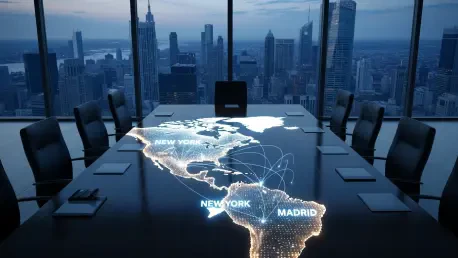

The stability of the American financial system currently faces a significant test as federal regulators weigh the implications of a massive cross-border banking acquisition that could reshape the economic landscape of the Northeast. United States Senators Bernie Moreno and Tim Sheehy have emerged as the primary voices of opposition, formally calling upon the Department of Justice, the Federal Reserve, and other key regulatory bodies to scrutinize Banco Santander’s proposed takeover of Webster Financial Corporation. This transaction involves a Connecticut-based institution with approximately $84 billion in assets, which, if integrated into the Spanish giant’s portfolio, would create a combined entity wielding roughly $327 billion in total assets. The lawmakers contend that allowing such a massive deposit franchise to fall under foreign control introduces unacceptable risks to national security and domestic financial integrity. They argue that the move could compromise the economic sovereignty of the United States by placing a critical piece of infrastructure under a foreign parent company.
The Implications of Foreign Centralization
The potential acquisition represents more than just a standard corporate expansion; it signals a fundamental shift in how a major American deposit franchise would be governed and managed. Critics are particularly wary of Santander’s “single bank” management strategy, which seeks to centralize control of its global operations directly from its executive headquarters in Madrid rather than maintaining autonomous regional leadership. This structure could lead to a significant loss of local oversight, effectively moving the levers of financial power away from the United States and into a jurisdiction with different regulatory priorities. Such a model raises questions about whether the needs of American consumers will remain a priority when decisions are made thousands of miles away. By shifting decision-making authority across the Atlantic, there is a legitimate risk that credit policies and financial stability will no longer be aligned with the specific requirements of the American communities the bank is intended to serve.
Building on this foundation, the concerns expressed by Senators Moreno and Sheehy emphasize that the transition from a regional, domestic lender to a foreign-controlled subsidiary poses unique risks to the Northeast. They contend that such a move could decouple the bank’s essential services from the local economic interests that are vital to regional prosperity, such as small business lending and municipal financing. If the parent company in Spain faces domestic economic pressure or a change in global strategy, the American subsidiary might be forced to retract credit or alter its risk appetite regardless of the health of the U.S. economy. This lack of local accountability is a primary driver behind the push for a more thorough investigation into how Santander intends to maintain the integrity of Webster Financial’s legacy operations. The debate highlights a growing tension between the benefits of global capital and the necessity of maintaining domestic control over the financial institutions that underpin everyday American commerce.
Geopolitical Threats and Sanctions Vulnerability
A central pillar of the opposition involves Santander’s historical track record regarding international sanctions and the management of geopolitical risk. Lawmakers have pointed to a disturbing incident occurring within the last few years where Iranian state actors reportedly used Santander UK accounts to move funds through a series of sophisticated shell companies. These transactions were allegedly linked to the Islamic Revolutionary Guard Corps Quds Force and various Russian intelligence operations, raising immediate alarms about the bank’s ability to screen for high-level security threats in real time. The ability of sanctioned regimes to bypass internal controls suggests that the bank’s defensive architecture may have systemic vulnerabilities that could be exploited by adversaries. If these lapses occur in European divisions, there is little reason to believe the American branch would be immune to similar infiltration, potentially turning a domestic bank into a conduit for illicit foreign influence and financing.
The senators use these documented lapses to highlight a systemic weakness in the bank’s internal compliance culture, arguing that the integration of Webster Financial could expose the broader American market to dangerous vulnerabilities. They maintain that if the bank’s existing controls were unable to prevent front companies for hostile regimes from accessing the financial system, then the current technical infrastructure does not yet meet the rigorous standards necessary to protect U.S. infrastructure. This skepticism is fueled by the belief that a bank’s compliance protocols are only as strong as its weakest link, and a history of failing to detect state-sponsored money laundering is a major red flag. From this perspective, approving the merger without exhaustive proof of remediation would be a gamble with national security. The argument suggests that the complexities of modern geopolitical warfare require financial institutions to possess an airtight vetting process that Santander has yet to demonstrate consistently on the global stage.
Evaluating Compliance Failures and Financial Governance
Beyond the immediate geopolitical concerns, the bank’s history with anti-money laundering protocols has come under intense scrutiny during the regulatory review process. Lawmakers have cited the reputation of certain European jurisdictions as potential hubs for illicit financial activity, specifically regarding the flow of narcotics trafficking funds from South and Central America. One notable example involved an entity known as “Beltcastle,” a financial intermediary with alleged ties to the Cali Cartel, which managed to utilize the bank’s services due to what were described as significant procedural oversights. This history suggests a pattern of negligence that could potentially grant criminal enterprises easier access to American markets if the acquisition proceeds. The fear is that the “compliance culture” of the parent company would be imported into Webster Financial, replacing the existing domestic standards with a more lax or flawed international framework that has already proven to be penetrable by organized crime.
Furthermore, the bank’s internal risk management and lending practices have faced criticism following several questionable financial decisions that resulted in significant losses. For instance, the bank’s exposure to First Brands, an auto-parts supplier that defaulted on substantial loans, is frequently cited as evidence of flawed corporate governance and a lack of proper due diligence. Despite the company’s clear financial instability and previous defaults, the bank reportedly increased its exposure to the firm, raising doubts about its ability to mitigate fraud and manage credit risk effectively. For the lawmakers involved, these recurring issues suggest that the burden of proof rests entirely on the acquiring entity to demonstrate it can be a stable and law-abiding steward of American assets. Such instances of poor judgment lead to concerns that a “single bank” management style would prioritize global volume over the sound, conservative lending practices that have historically characterized the American regional banking sector.
Ensuring Resilience Through Stringent Oversight
To address the multifaceted risks identified by Congressional leaders, federal regulators should implement a specialized oversight framework that transcends traditional merger reviews. Instead of focusing solely on market concentration, the Department of Justice and the Federal Reserve must demand a comprehensive audit of the bank’s global compliance systems by an independent third party. This audit should specifically target the effectiveness of automated screening tools and the transparency of the “single bank” management model to ensure that American regulators maintain full visibility into all domestic transactions. Furthermore, any approval should be contingent upon the establishment of a localized board of directors with the legal authority to override decisions made in Madrid if they conflict with U.S. national interests or regional economic stability. Such measures would provide a necessary buffer against the centralization of power while ensuring that the institution remains responsive to the unique demands of the American market.
Looking ahead, the resolution of this acquisition will likely set a precedent for how the United States manages the entry of foreign entities into its core retail banking sector. Regulators must prioritize the creation of “firewalled” operational structures that prevent the contagion of compliance failures from overseas divisions into the American financial ecosystem. Future considerations should include the development of more rigorous “know your customer” requirements that are specifically tailored to the risks of foreign ownership, ensuring that the bank cannot be used as a backdoor for sanctioned capital. By enforcing these high standards now, the government can protect the integrity of the financial system while signaling to global markets that access to American deposits is a privilege conditioned on absolute transparency and security. The ultimate goal should be to transform this challenge into an opportunity to strengthen the resilience of the banking sector against the evolving threats of the current decade.